
Imagine I place a coin on the table and offer you a simple bet. If it lands on heads, I will give you $15. If it lands on tails, you give me $10.
Would you take it?
The math is straightforward. You have an equal chance of winning or losing, but the potential gain is larger than the potential loss. If we played the game repeatedly, you would expect to come out ahead. On average, each flip is worth $2.50 to you.
Yet many people will not take the bet.
Some reject it immediately. Others hesitate, ask questions, or try to renegotiate the terms. What if the prize were $20? What if the loss were only $5? What if we flipped the coin three times instead of once?
If you were 100% rational, you would favor any bet that offers more when you win than when you lose, but our emotions do not experience the two possible outcomes equally. While winning $15 feels good, losing $10 feels horrible and even threatening.
That imbalance is the essence of loss aversion, one of the most influential, and frequently oversimplified, ideas in behavioral science. It helps explain why people hold on to bad investments, resist organizational changes, stay in unsatisfying jobs, postpone difficult conversations, and protect familiar routines long after those things have stopped serving them.
Turn today's insights into tomorrow's habits. Shop our science-backed behavior change tools and save 10% with code SUBSTACK10.
Why Losing Feels Different
Daniel Kahneman and Amos Tversky introduced the idea as part of Prospect Theory in 1979. Prospect Theory was their groundbreaking account of how people make decisions involving risk and uncertainty.
Traditional economic theories generally assumed that people evaluate choices according to how those choices affect their total wealth (or wellbeing). Kahneman and Tversky brought in a bit of psychology and argued that this is not how our minds typically work.
Instead, we judge gains and losses relative to one of the following reference points:
- What we currently have
- What we expected to have
- What we believe we deserve
- Consider two employees who each receive a 5 percent raise.
- One had expected no increase and experienced the raise as welcome recognition.
- The other had thought they were in line for a 10 percent increase. Objectively, they received the same amount, but it didn’t feel the same way for the two of them,
Psychologically, one experienced a gain while the other experienced a perceived loss.
Prospect theory proposed that the psychological response to outcomes is steeper on the loss side of the reference point than on the gain side. In everyday language, losing something often affects us more than gaining something of comparable value.
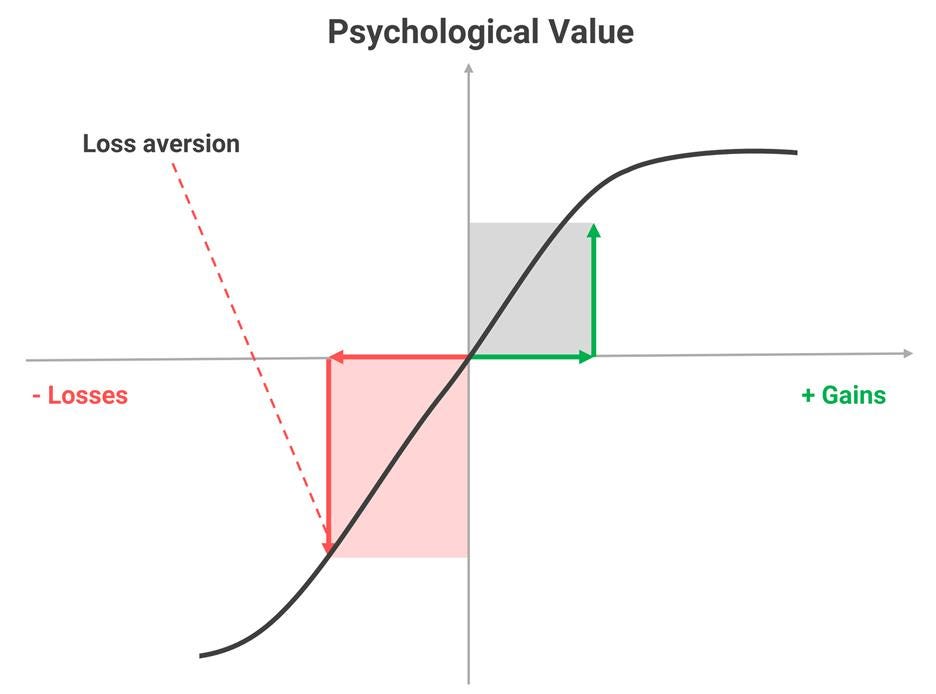
This finding is commonly reduced to the claim that losses hurt approximately twice as much as equivalent gains feel good.
That statement is memorable, but it should not be treated as a fixed law of human nature.
Tversky and Kahneman’s later modeling produced an estimated loss-aversion coefficient of 2.25, but subsequent studies have found considerable variation. A recent meta-analysis concluded that loss aversion is real in many risky-choice settings while also finding a lower average estimate and substantial differences across studies, individuals, and experimental designs.
The more useful lesson is not that every loss is precisely twice as powerful as every gain. It is that potential losses frequently receive disproportionate psychological weight and we are not always aware that this weighting is shaping our judgment.
The Coin Flip is More Complicated Than it Looks
It would be easy to look at someone who rejects the $15-to-$10-coin flip and declare that person irrational. But that conclusion moves too quickly.
A single bet still contains genuine risk. Ten dollars may mean very little to one person and lunch for another. Some people simply dislike gambling (we all have a risk profile that is different). Others place a high value on certainty or have learned through experience to distrust seemingly attractive offers. The expected value may be positive, but expected value is not the only thing people reasonably care about.
The more revealing version of the problem is not one isolated flip. It is what happens when the same kind of choice appears repeatedly.
Imagine being offered the bet 100 times. You could still lose on any individual flip, but the repeated positive advantage would make it increasingly likely that you would come out ahead overall. With the 50/50 odds of each individual flip and a higher potential win per (+$15) than loss (-$10) per flip, statistically you will likely come out financially ahead. Note we say likely because, as Annie Duke highlights, even a 99% chance of a win is still a 1% chance of loss meaning it is not a guarantee. The point though is that continually refusing favorable opportunities because each one contains a chance of loss could become costly.
Many meaningful decisions are like this. Applying for one competitive job may end in rejection. Applying for a series of well-matched roles creates a portfolio of opportunities. Sharing one unconventional idea may draw criticism. Developing a practice of testing and refining ideas creates learning. Trying one new form of exercise may be unpleasant. Experimenting with several may help you discover an activity that fits your life.
Loss aversion can lead us to treat each attempt as an all-or-nothing referendum on our ability, identity, or future. We become so focused on the possibility of losing this particular bet that we fail to consider the cost of refusing every bet.
The question is no longer simply, “What if this goes badly?”
It becomes, “What happens to my life if I keep protecting myself from every possibility of failure?”
The Hidden Comfort of Doing Nothing
Most difficult decisions contain an option that does not feel like an option at all: leaving things as they are.
- Keep the job
- Avoid the conversation
- Renew the subscription
- Continue funding the project
- Maintain the routine
- Wait another six months
Doing nothing feels psychologically neutral because it preserves our current reference point. We do not experience ourselves as actively choosing the status quo. We experience ourselves as refraining from making a choice.
Yet the status quo is still a choice, and it can carry significant costs.
Research by William Samuelson and Richard Zeckhauser demonstrated that people are disproportionately likely to select an option when it is framed as the current or default position. This status quo bias has been observed in choices involving investments, employee benefits, health plans, public policy, and everyday consumer decisions. Loss aversion is not the only reason we prefer the familiar, but it helps explain why leaving an existing position can feel more consequential than entering it ever did.
The losses attached to change are usually vivid. Leaving a job may mean giving up respected colleagues, a familiar routine, accumulated status, and the reassuring feeling of knowing how the system works. Starting a new career may require accepting a temporary reduction in income or competence. One may even need to move (which involves another whole set of losses that need to be examined).
The losses created by staying still are usually less dramatic. They arrive slowly, often without a clear moment at which we can say the damage occurred. Another year passes without professional growth. Resentment gradually replaces trust. Physical strength declines. A promising idea becomes something we once talked about doing.
This creates a powerful asymmetry. Action comes with visible costs. Inaction often comes with invisible ones.
As a result, remaining in a deteriorating situation can feel safer than moving toward a better but uncertain alternative. We compare the known benefits of what we have with the possible problems of what might replace it. The key or interesting part here is that we rarely conduct the comparison in the opposite direction.
When Fear Sounds Like Prudence
Loss aversion rarely feels like fear. It tends to arrive wearing the clothes of logic:
- “This isn’t the right time.”
- “I should wait until I know more.”
- “It would be irresponsible to leave.”
- “At least I know what I’m dealing with.”
- “I’m simply being realistic.”
Sometimes these statements are entirely reasonable. The world is full of risks that should not be dismissed or minimized. Jobs provide health insurance and stability, relationships deserve care rather than impulsive exits, and investments should not be sold merely because they decline. Familiarity has real value and change frequently carries costs that motivational advice conveniently ignores.
The challenge is that loss aversion can imitate good judgment. It encourages us to examine what action might cost in extraordinary detail while treating inaction as though it were free. The new opportunity must justify itself. The current situation is rarely asked to do the same.
Someone considering a new job may create a long list of uncertainties:
- What if the manager is difficult?
- What if the culture is worse?
- What if the company reorganizes?
Those are legitimate questions. But the person may spend much less time asking what another three years in the existing role could cost in motivation, learning, earning potential, or confidence.
Someone avoiding a difficult conversation may tell themselves they are protecting the relationship – and that is often true. But they may also be protecting themselves from short-term discomfort while allowing a larger problem to deepen.
Or, as the Sunk Cost Fallacy shows us, someone who continues funding a struggling project may insist that abandoning it would waste everything already invested. The time and money already spent, however, cannot be recovered by spending more. What matters is whether the next dollar or the next month is still likely to produce value.
Loss aversion becomes most dangerous when it remains invisible. When we fail to recognize it, we can mistake an emotional preference for the familiar as objective evidence that the familiar is best.
Loss Aversion Has Limits
Because loss aversion is intuitive and broadly applicable, it is tempting to use it as a universal explanation. That would be a mistake.
Researchers have identified important limits to when and how loss aversion appears. Nathan Novemsky and Daniel Kahneman argued that not everything we give up is coded psychologically as a loss. Money spent in an expected exchange, for example, may be experienced differently from money unexpectedly taken away. A person buying dinner does not necessarily feel the full pain of “losing” the purchase price because the money was intended to be exchanged.
Other researchers have found that apparent loss aversion can weaken or disappear depending on the size of the stakes, the way choices are described, the available alternatives, and whether people have extensive experience with a decision. Some critics have also argued that behaviors attributed to loss aversion may partly reflect other forces, including inertia, attention, transaction costs, ownership, regret, or simple uncertainty about an unfamiliar option.
These challenges make this study more precise.
Someone may stay in an unfulfilling job partly because of loss aversion, but they may also need stable health insurance, face a weak labor market, care deeply about their colleagues, or have accurate doubts about the available alternatives. Someone may avoid a conversation because they fear losing the relationship, but they may also be waiting until they are calm enough to handle it constructively.
Behavioral science is at its best when it enlarges our understanding rather than shrinking every behavior into a single label. Loss aversion should be treated as a question to investigate, not a diagnosis to impose.
Step 1: See the Loss on Both Sides.
The most useful way to work with loss aversion is not to eliminate it. That would be neither possible nor desirable. Sensitivity to loss protects us. It makes us cautious around genuine danger, encourages us to preserve resources, and helps us avoid casually abandoning things that matter.
The goal is to examine the entire decision rather than only the losses associated with change.
Step 2: Name what you fear losing.
Be more specific than “security” or “comfort.” Use concrete language to define specifically what you are protecting, whether that is income, status, competence, belonging, predictability, an identity, or the belief that a previous choice was correct?
Once the feared loss has a name, it becomes easier to assess whether it is as large or permanent as it feels.
Step 3: Ask what you may be losing by not acting.
This is the question loss aversion tends to hide from us.
- What might another year in the same position cost?
- What happens to trust if the conversation never occurs?
- What opportunities disappear while you wait for certainty?
- What will your health, finances, skills, or relationships look like if the current trajectory continues?
This does not mean that action is always preferable. It means that inaction deserves to appear on the ledger.
Step 4: Look for ways to make the decision smaller and more reversible.
Loss aversion becomes especially powerful when a choice feels permanent. Experiments can reduce that pressure.
- Before changing careers, talk with people already doing the work.
- Before leaving a job, test a side project or acquire one relevant skill.
- Before committing to an ambitious exercise program, try several activities and see which one fits.
- Before initiating a sweeping confrontation, begin with one honest question.
These smaller steps do not eliminate uncertainty. They purchase information. They transform a frightening, irreversible leap into a series of manageable bets.
Using Loss Aversion to Protect Progress
The same force that keeps us stuck can also help us continue.
Once progress becomes part of our reference point, we often become motivated to protect it. This is why streaks, visible milestones, savings balances, completion bars, and “don’t break the chain” systems can be effective. We stop viewing the behavior solely as an opportunity to gain something in the future. We begin to see the progress already made as something we could lose.
- A person who has exercised consistently for a month may no longer be motivated only by the distant promise of better health. They may also want to preserve their identity as someone who exercises.
- A writer with 30-completed pages has more to protect than a writer facing a blank screen.
- A person who has built an emergency fund may become more motivated to avoid unnecessary spending because the accumulated balance feels tangible.
This strategy needs to be used carefully. A perfect daily streak can become so fragile that one missed day feels like a total loss. Once the streak is broken, motivation can collapse.
A better approach is to protect continuity without demanding perfection. Track the number of workouts completed each week rather than requiring an unbroken daily sequence. Measure meaningful attempts, not only flawless outcomes. Decide in advance how you will restart after a lapse.
The goal is not to create a system that says, “Never fail.”
It is to create one that says, “Do not casually surrender what you have built.”
The Other Side of the Bet
Return to the coin on the table.
Heads, you gain $15. Tails, you lose $10.
There is no universally correct response. The choice depends on your circumstances, your tolerance for uncertainty, what the money means to you, and whether this is one isolated wager or one of many opportunities you will encounter.
But the discomfort created by the bet reveals something important. We do not experience possible futures symmetrically. The threat of losing what we possess often feels more immediate than the possibility of obtaining something better.
That may be useful when the loss is serious and the alternative is reckless. It becomes less useful when the fear of giving something up prevents us from noticing that it is already costing us.
Understanding loss aversion is not an invitation to become fearless. It is an invitation to examine what our fear is protecting, and what it may be preventing.
Before rejecting the next uncertain opportunity, ask yourself three questions:
- What could I lose by acting?
- What could I gain?
- And what might I already be losing by refusing to move?
Sometimes the wise choice is to protect what you have.
Sometimes the bigger risk is allowing the fear of loss to make the decision for you.
Keep Shifting,
Ready to turn today's insights into lasting change? Explore our science-backed journals, planners, and behavior change tools designed to help you put these ideas into practice every day. Use code SUBSTACK10 for 10% off at checkout.
This Week’s Shift
A weekly reminder to rethink, reflect, and act:
What important decision have you been postponing? What are you afraid of losing? What might you already be losing by staying exactly where you are?
Listen
Go deeper into this week’s topic:
Thoughtful Reads
Curated ideas to inspire reflection:
Every week in Behavior Shift Weekly, we share ideas grounded in behavioral science and psychology, practical tools to help you think differently, act intentionally, and build the life you actually want.
References
-
Benartzi, S., & Thaler, R. H. (1995). Myopic loss aversion and the equity premium puzzle. The Quarterly Journal of Economics, 110(1), 73–92.
-
Ert, E., & Erev, I. (2013). On the descriptive value of loss aversion in decisions under risk: Six clarifications. Judgment and Decision Making, 8(3), 214–235.
-
Kahneman, D., & Tversky, A. (1979). Prospect theory: An analysis of decision under risk. Econometrica, 47(2), 263–292.
-
Novemsky, N., & Kahneman, D. (2005). The boundaries of loss aversion. Journal of Marketing Research, 42(2), 119–128.
-
Samuelson, W., & Zeckhauser, R. (1988). Status quo bias in decision making. Journal of Risk and Uncertainty, 1, 7–59.
-
Tom, S. M., Fox, C. R., Trepel, C., & Poldrack, R. A. (2007). The neural basis of loss aversion in decision-making under risk. Science, 315(5811), 515–518.
-
Tversky, A., & Kahneman, D. (1992). Advances in prospect theory: Cumulative representation of uncertainty. Journal of Risk and Uncertainty, 5, 297–323.
-
Walasek, L., Mullett, T. L., & Stewart, N. (2024). A meta-analysis of loss aversion in risky contexts. Journal of Economic Psychology, 103, 102740.