
We have been a little remiss in putting out this blog lately. Our team has been heads down working on something really exciting and it has taken a lot of our focus. But it has also given us a good perspective on getting lost in creation.
Over the past year we have been writing, illustrating, and publishing a kid’s book based on the Habit Loop Theory, popularized by Charles Duhigg. Baby Rabbit Builds a Habit is open for preorders and officially arrives on October 13th!
It has been a very rewarding process of creativity. So, in that vein, I’d like to talk about something Dan Pink recently shared on LinkedIn about Brain Rot. In his post, he describes something uncomfortably familiar - the uneasiness you feel when your phone isn’t near, a difficulty focusing for long periods, and the “meh” that can overtake experiences that should otherwise feel enjoyable.
We’ve talked before about how our phones and social media are designed to capture attention. Notifications, infinite scrolling, recommendations, likes, messages, and algorithms all create a steady stream of small rewards. When our brains become accustomed to that level of constant stimulation, instead of settling into the slower rewards of reading a book, taking a walk, having a conversation, learning something difficult, or working toward a meaningful goal, we find ourselves reaching for that next little quick hit of dopamine.
As Dan said, “Brain rot. It’s not just a Gen Z buzzword. It’s a biological reality. After 30 years of studying human development, I have hunch about what’s going on: Your brain is running 100,000-year-old hardware on 2026 software. And it’s crashing.”
Dan offered a few recommendations on how to overcome this urge that you can see in his original post, but one stood out above all else that we would like to focus on. He offered a simple suggestion that stuck with us: Create more than you consume.
We have become very good at consuming
Many of us spend a significant portion of our days taking things in – “reading” posts, watching videos, half-listening to podcasts, scrolling through photos, skimming the news, answering messages, browsing products, consuming entertainment, and attempting to absorb (or maybe just find distraction in) a seemingly endless stream of info.
If you want to get a little more philosophical about it, Mathew Shribman’s post on Medium does a great job. For now, let’s stay focused on Dan’s advice.
Consumption is fundamentally different from creation. There is a certain satisfaction that can only come from taking an idea that exists in your head and turning it into something tangible. Even if it… kinda sucks. You don’t have to paint the Mona Lisa, you just have to make something.
That might be part of what we are losing as our lives become increasingly digital. We have become incredibly efficient at consuming other people’s ideas, images, opinions, music, writing, humor, and creativity. We have become less practiced at sitting with our own thoughts long enough to make something from them.
Creation doesn’t have to be impressive
When we say “create,” many people immediately picture an famous artist, a bestselling author, a headlining musician, or a master craftsman building something with their hands.
We might think, “well I can’t do that, so why bother?” But that’s not the part that really matters. And, it doesn’t have to be for other people.
In recent conversation about this subject, Kurt discussed how he paints, despite openly admitting that he paints horribly. I (Ben) have sketches and half-finished ideas scattered around from years of drawing, including designs for houses that will probably never be built. Some of them are objectively strange and many may never leave a notebook. Yet, I still sketch them out and put them on paper.
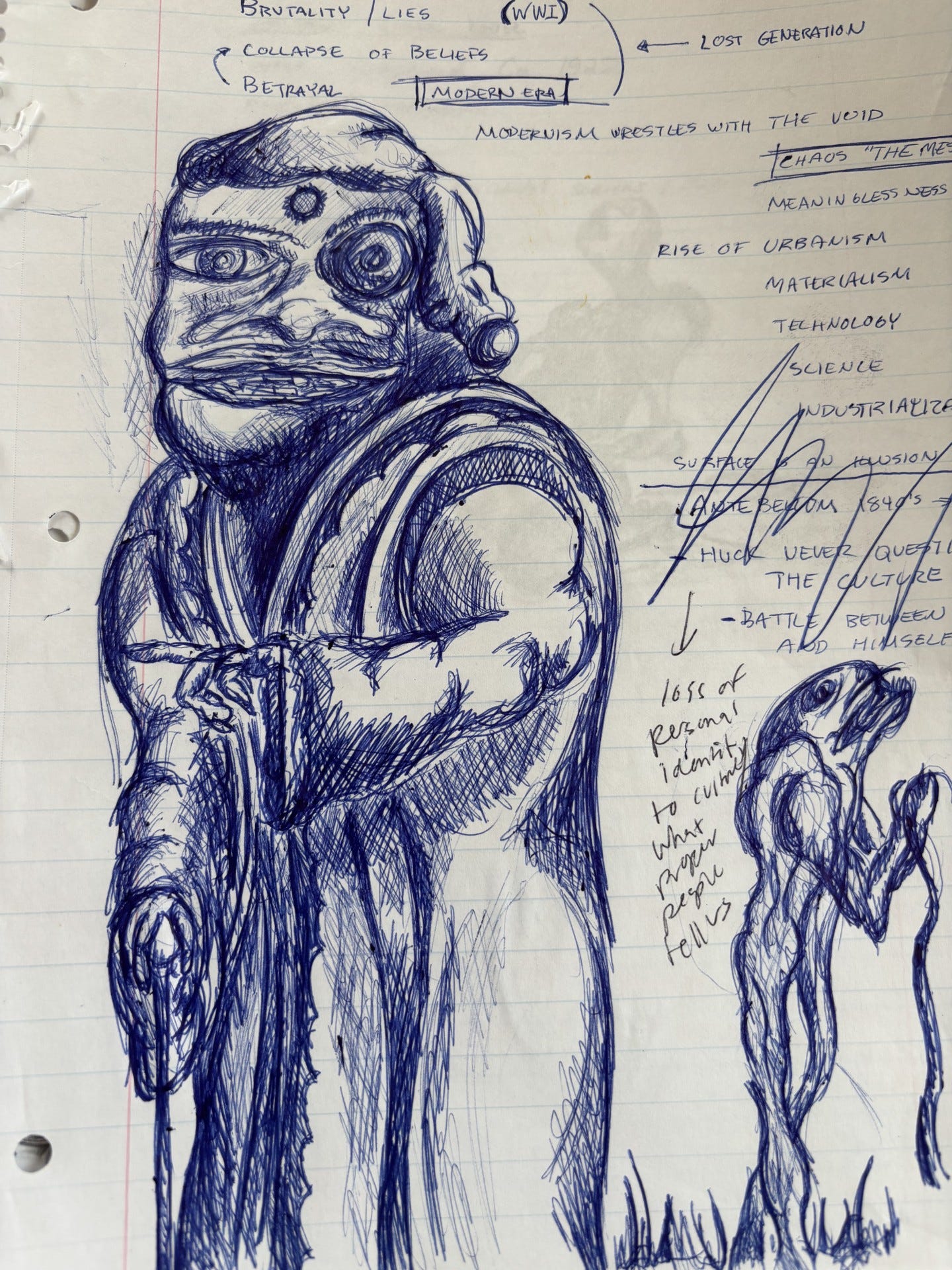
The value isn’t in the finished product, it’s in the act of getting the idea out of your head and into the world. In fact, that weird cover photo on this article? It’s from a college notebook I recently found. It appears to have been a distraction during a class on modernism and how a loss of identity within the lost generation led to a new form of urbanism after WWII? Either way, it was never intended to be scrutinized by the public eye but I am sure I enjoyed sketching it. Here it is in all its strange glory.
Writing can work the same way. You can write something nobody else will ever read. You can jot down an observation from a trip, an idea that occurred to you in the shower, a memory you don’t want to forget, or a thought you haven’t quite figured out yet.
Cooking counts, too. So does gardening. Playing guitar counts, even if you only know three chords. Rearranging your office so that it feels like your space again might count. Building something, fixing something, sketching something, taking photographs, making a playlist, planting something, or sitting down with a friend and exchanging ideas can all be forms of creation.
Creation doesn’t have to be good, it just needs to be “yours.”
There is an important distinction in Pink’s advice: he doesn’t say consume less. He says create more than you consume.
Social media, podcasts, books, articles, and videos can be wonderful sources of inspiration. They can introduce us to ideas we never would have encountered on our own. The hang up happens though when we consume without doing anything with what we consume.
Imagine scrolling past an idea that genuinely interests you. The normal pattern is to absorb it, enjoy the little spark of novelty, and keep scrolling. What if, instead, you stopped?
Write the idea down, reflect on it, sketch something inspired by it, talk about it with someone. Turn it into something. Now consumption has become the beginning of creation.
That is a fundamentally different relationship with the information. You aren’t simply allowing the internet to fill your head. You are using what you encounter as raw material for your own thinking.
Create something that nobody sees
There is another part of this that may be particularly important in a world where almost everything can be shared - creation does not need an audience. Yup, I said it.
In fact, it might be worth deliberately creating things that you never share. Hence the weird houses filling my notebooks.
We have become accustomed to looking at creativity in terms of output and validation. Make something, post it, see how many people like it, check the comments, watch the engagement, and then decide whether what you made was worthwhile.
But that painting hanging in the basement hallway of your house can be worthwhile even if nobody else sees it, the notebook filled with strange thoughts can be worthwhile even if nobody reads them (maybe in this case its better if they don’t) and a terrible sketch can be worthwhile simply because you enjoyed making it.
Even a meal you cook for yourself can be worthwhile even if you eat it alone and never photograph it.
A few months ago in fact, my wife was on a solo trip hiking in the Dolomites. We love to travel together but we also encourage each other to pursue our own adventures (which is how, last year, I found myself in central Afghanistan with a pair of backcountry skis looking at some of the most breathtaking lines I have ever seen… but that’s a story for another time). Anyways, while she was in Italy I took it upon myself to cook “the best burger I ever made.” I very rarely eat a burger so when I do, I want to really enjoy it. To top it off, I have always loved to cook but as relatively new parents – chicken and rice or takeout had been on the menu far too often those days. So, I went to the store and shopped for all the right ingredients, put my daughter to bed, and cooked. I sat in silence at the table by myself with an IPA and just enjoyed it. There is no permanent record of this burger, but you know what? Damn did I enjoy making it.
There is something different about creating when the reward is intrinsic rather than social. You’re not performing or optimizing for an algorithm. You’re not trying to build a personal brand, you’re just making something because you wanted to make it.
Keep on shifting,
Ready to turn today's insights into lasting change? Explore our science-backed journals, planners, and behavior change tools designed to help you put these ideas into practice every day. Use code SUBSTACK10 for 10% off at checkout.
This Week’s Shift
A weekly reminder to rethink, reflect, and act:
Look at how much time you spend consuming this week, then find a small way to tip the balance toward creation.
Start small: if you spend 10 minutes scrolling, spend ten minutes writing, fifteen minutes in the garden, a sketch before bed, a new recipe, a few chords on the guitar, or a notebook where you capture ideas instead of immediately moving on to the next thing.
And don’t worry about whether it is productive. You can create something simply because it feels good to create it. It can be a meal, a garden, an idea, a conversation, a sketch, a rearranged room, a page in a notebook, or anything else that takes something from inside your head and gives it a form, any form, in the world.
Listen
Go deeper into this week’s topic:
Thoughtful Reads
Curated ideas to inspire reflection:
- How we spend our day (not really a read but still cool)
- The opposing views of intellectual property rights
- The Kessler Syndrome Edition
Every week in Behavior Shift Weekly, we share ideas grounded in behavioral science and psychology, practical tools to help you think differently, act intentionally, and build the life you actually want.