
Some decisions arrive politely. They give you time to think, compare options, ask for advice, and sleep on it.
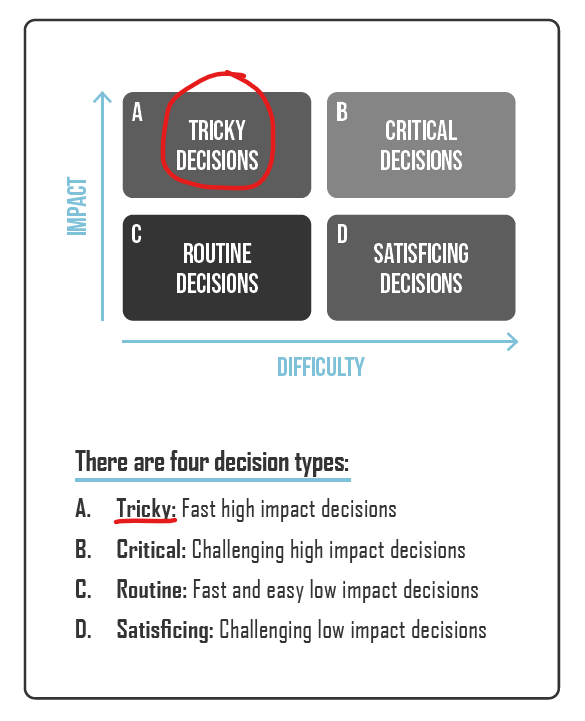
“Tricky Decisions,” high impact, low difficulty on the decision quadrant, do not.
They show up with urgency. The shelter calls and says the puppy you were thinking about adopting has another family interested. Your friend texts about a stock that is “about to take off.” Your boss asks you to choose between which contract they should sign – and he needs the answer right now. You are furious after a conflict at work and suddenly quitting feels not only reasonable, but necessary. After an evening of drinking, someone says, “Come on, it’s not that far. I can drive.”
These decisions feel quick and doable and that is what can make them risky.
In the Decision/Shift model, Tricky Decisions are high-impact but low-difficulty or time-compressed decisions. They are not necessarily complicated in the way buying a house or choosing a career path can be, but they matter. They can affect your money, health, relationships, reputation, safety, or long-term goals. Tricky Decisions are “fast high impact decisions” that should not be made without thought, even if they seem easy to make in the moment.
The challenge is that the moment itself is often working against us.
Why Tricky Decisions Hijack Our Judgment
Tricky Decisions tend to happen under emotional pressure, time pressure, social pressure, or uncertainty. That combination pulls us toward fast, automatic thinking.
Remember the System 1 vs 2 thinking we discussed in our Substack a few weeks ago? Tricky Decisions tend to fall under System 1 thinking processes. But, because their outcomes are significant, there is a greater need to consciously slow down and push the decision into more reflective thinking (i.e., System 2).
If a car swerves toward you, System 1 is there to help -- you do not want a committee meeting in your head, you want fast reaction. But if a salesperson says, “This deal expires today,” or your anger says, “Send the email now,” fast thinking from System 1 may be serving the emotion more than the outcome.
George Loewenstein’s work on hot-cold empathy gaps helps explain why. When we are in a “cold” state, calm and emotionally regulated, we often mis-predict what we will do in a “hot” state, such as anger, fear, hunger, excitement, craving, or social pressure. In hot states, immediate feelings can dominate long-term preferences.
That is the Tricky Decision trap: the version of you making the decision now may not be the version of you who must live with it in the future.
The Biases Riding in the Back Seat
Tricky Decisions are vulnerable to a specific cluster of biases.
- Scarcity makes an option feel more valuable because it might disappear. Robert Cialdini’s work on persuasion identifies scarcity as one of the major principles that shapes compliance and influence. Limited-time offers, exclusive opportunities, and “only one left” messages all make the decision feel more urgent and more valuable than it may actually be.
- The bandwagon effect pulls us toward what others are doing. If everyone is buying the stock, joining the trend, investing in the opportunity, or saying “you have to try this,” social proof starts to substitute for analysis.
- Overconfidence tells us, “I’ve got this.” It is especially dangerous after recent success, when we start to mistake a good outcome for a good process.
- Base-rate neglect makes us outweigh the vivid story in front of us and underweight the broader odds. Kahneman and Tversky’s 1973 work on base rates showed how people often underuse prior probabilities when they are given more vivid individuating information.
- And hot states, as we have already noted, narrow the frame. Anger says respond. Excitement says buy. Fear says escape. Desire says now.
None of these biases mean we are foolish. They mean we are human. Tricky Decisions exploit normal human tendencies in moments where the consequences can be larger than the thinking we give them.
The Goal Is Not to Stop. It Is to Slow Down Just Enough.
Critical Decisions often need a full decision process. Research, reflection, multiple perspectives, structured comparison.
Tricky Decisions usually do not give you that luxury.
That is why they require micro-tools. Not a weekend retreat, but just enough structure to interrupt the emotional momentum and give your reflective mind a chance to enter the room.
Think of these tools as speed bumps. They do not stop the decision, they keep you from flying through it at the wrong speed.
Tool 1: Two Breaths / Seven Breaths
The simplest intervention is to pause to breathe before deciding.
Two Breaths is the micro-pause. In through the nose, out through the mouth, twice. It gives you a moment to recognize, “I am making a decision.” But this is also a way to slow down decisions without getting stuck in analysis paralysis. The idea is to take at least two breaths before deciding and to decide by the seventh breath when the stakes do not require a longer process.
That small pause matters because Tricky Decisions are often made before we even realize we are choosing.
- A friend says, “Are you okay to drive?”: Two breaths.
- Your boss says, “Can you commit to this by Friday?”: Four breaths.
- You are about to send the angry email: Seven breaths.
Breathing does not magically make you wise, it creates enough space for wisdom to have a chance.
Tool 2: When/Then Plans
The best time to make a Tricky Decision is often before the tricky moment arrives.
Psychologist Peter Gollwitzer’s research on implementation intentions shows that simple “if-then” plans can help people act in line with their goals. The structure is straightforward: “When situation X arises, I will do Y.” These plans link a specific cue to a specific response, making the desired action more automatic when the moment arrives.
In Decision/Shift language, we often frame this as When/Then planning. The tool is designed for situations where hot states, bad habits, or reactive choices can pull us away from what we would choose in a calmer state.
For Tricky Decisions, this is incredibly useful.
- When I have had more than 1 beer, then I do not drive. I call a ride.
- When I am angry after a work conflict, then I draft the message but do not send it until tomorrow.
- When I see a pet I want to adopt, then I wait 24 hours and review the care, cost, and time commitment.
- When I hear a hot investment tip, then I compare it to the base rate and sleep on it.
This is not about removing freedom. It is about letting your calmer-self protect your future-self from your reactive-self.
Tool 3: The 60-Second Future-Me Check
A Tricky Decision narrows your attention to the present. The Future-Me Check widens it again.
Ask two questions:
- What is the worst-case outcome if I do this?
- What would Future Me thank me for?
That first question interrupts overconfidence. It forces you to consider downside, not just desire.
The second question shifts the frame from immediate feeling to identity and values. It moves you from “What do I want right now?” to “What kind of person am I trying to become?”
For example, imagine you are tempted to quit after a brutal meeting. The worst case might not simply be “I leave a bad job.” It might be “I burn a relationship, lose leverage, and make a major career decision while angry.” Future You might still decide to leave, but they would probably thank you for doing it with a plan.
Or imagine the shelter puppy. Worst case? You adopt a pet you cannot realistically care for, creating stress for you and instability for the animal. Future You might thank you for waiting one day, reviewing the real responsibilities, and then deciding with a clearer head.
The point is not to talk yourself out of everything. Sometimes the right decision is yes. Sometimes it is no. The goal is to make sure the decision is aligned with more than the emotion of the moment.
Tool 4: Bias Flags
Because Tricky Decisions move fast, it helps to have a few warning labels ready.
- If you hear “only today,” flag scarcity. Ask: Would I still want this if it were available tomorrow?
- If you hear “everyone is doing it,” flag bandwagon. Ask: Why are people doing this – what do they get from it?
- If you hear “I’ve got this,” flag overconfidence. Ask: What would make me wrong?
- If you feel angry, hyped, scared, tempted, or desperate, flag hot state. Ask: Would I make the same choice tomorrow morning?
- If the decision is based on one vivid story, flag base-rate neglect. Ask: What usually happens in situations like this – what is the base rate of occurrence?
These questions do not need to take long. They are not meant to replace judgment. They are meant to wake judgment up.
A Few Tricky Decisions in the Wild
Consider the hot stock tip. The story is vivid. Someone made money. The window feels urgent. Other people seem to be getting in. This is scarcity, bandwagon, overconfidence, and base-rate neglect having a party in your brain.
The Tricky Decision response is not necessarily “never invest.” It is this:
- Take two or three breaths. Think about what the base rate is.
- Then ask, “what percentage of my portfolio am I willing to risk?” Would I make this choice if I had not heard the exciting story? And finally, can I sleep on it?
Or take the angry resignation. You have a terrible interaction at work. Your body is charged. Your story feels complete. “I am done.” Maybe you should leave. But maybe you should not decide from the hottest point of the experience.
- Draft the email, but do not send.
- Call one trusted person and talk to them.
- Ask what Future You would thank you for.
- Decide on a timeline to make the decision – but don’t make the decision while running hot.
Or the pet adoption. It feels like love at first sight. And it might be the start of a wonderful chapter. But love at first sight still has vet bills, travel constraints, daily care, and ten-plus years of responsibility. Try a when, then rule:
- When I want to adopt, then I wait 24 hours and review the checklist.
That rule does not kill joy. It protects commitment.
The One-Sentence Review
After a Tricky Decision, do a quick review. What helped or hurt my decision process?
One sentence is enough.
- “I almost bought because of scarcity, but waiting helped.”
- “I sent the email while angry and made things worse.”
- “I called a ride because my When/Then rule was already set.”
This is how you train your future decision-making. You are not just judging outcomes. You are improving process.
Annie Duke has argued that good outcomes and good decisions are not the same thing. You can make a bad decision and get lucky. You can make a good decision and get unlucky. The Decision/Shift materials echo this idea through the Outcome Quality Box, which separates decision quality from outcome quality.
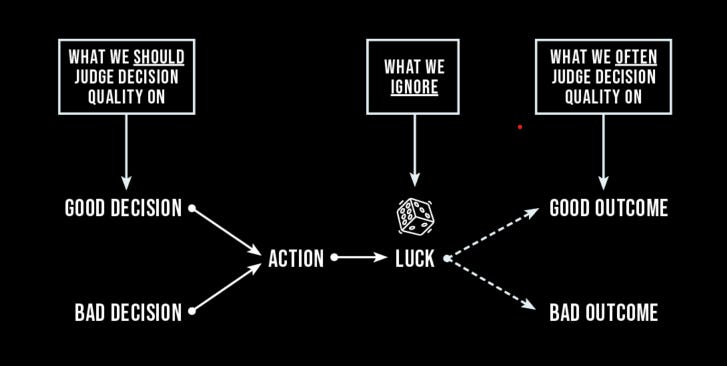
That distinction matters because Tricky Decisions can fool us. Driving after drinking and arriving safely was not a good decision. Buying a risky stock and making money does not prove the process was sound. Sending an angry message and getting your way does not mean it was wise.
The goal is not just fewer bad outcomes. It is better decision habits.
The Tricky Decision Playbook
When you recognize a Tricky Decision, do not try to become a perfect decision-maker. Use a simple playbook.
- Breathe first. Use Two Breaths / Seven Breaths for a micro-pause.
- Flag the bias. Scarcity, bandwagon, overconfidence, hot state, or base-rate neglect. This helps you name the agent acting against your best interest and be more aware of how you can respond.
- Ask the Future-Me Check. What is the worst case? What would Future Me thank me for?
- Use a When/Then rule. Pre-decide what your calmer self wants your reactive self to do.
- Review one sentence afterward. What helped or hurt?
Tricky Decisions will always feel fast. That is their nature.
Your job is not to make them slow. Your job is to make them just slow enough to serve your values.
Keep shifting.
Ready to take your decision making to the next level? Try our Decision Shift Behavior Change Guide today. Use code SUBSTACK10 for 10% off at checkout.
This Week’s Shift
A weekly reminder to rethink, reflect, and act:
Identify a tricky decisions you are facing or have faced.
- If you are facing it, run it through one (or more) of the decision tools in this article
- If it was in the past, do a one sentence review and ask yourself:
- If it was a positive outcome: Did I make a good decision or get lucky?
- If it was a negative outcome: Did I make a bad decision or just have a bad outcome?
Listen
Go deeper into this week’s topic:
Thoughtful Reads
Curated ideas to inspire reflection:
Every week in Behavior Shift Weekly, we share ideas grounded in behavioral science and psychology, practical tools to help you think differently, act intentionally, and build the life you actually want.
References
-
Cialdini, R. B. (2001). Harnessing the science of persuasion. Harvard Business Review.
-
Duke, A. (2018). Thinking in Bets: Making Smarter Decisions When You Don’t Have All the Facts. Portfolio.
-
Gollwitzer, P. M. (1999). Implementation intentions: Strong effects of simple plans. American Psychologist, 54(7), 493-503.
-
Kahneman, D. (2011). Thinking, Fast and Slow. Farrar, Straus and Giroux.
-
Kahneman, D., & Tversky, A. (1973). On the psychology of prediction. Psychological Review, 80(4), 237-251.
-
Loewenstein, G. (2005). Hot-cold empathy gaps and medical decision making. Health Psychology, 24(4S), S49-S56.
-
Tversky, A., & Kahneman, D. (1974). Judgment under uncertainty: Heuristics and biases. Science, 185(4157), 1124-1131.