
Big, life-changing goals are exciting to dream about…but often overwhelming to execute.
If you’ve ever looked at a goal and thought, “Where do I even start?” you’re not alone. We’ve all been there at one time or another.
On the Behavior/Shift Show, we often joke that setting a Keystone goal is the easy part. Achieving it? That’s where things get real. When a goal feels enormous - writing a book, switching careers, running a marathon - it’s a bit like staring up at a mountain and wondering how you’re supposed to get to the top.
And as we say: nobody climbs a mountain in one leap. You take it step by step.
So today, we’re looking at the science, and the practice, of breaking BIG goals down into manageable chunks.
Let’s dig in.
Get a head start on your 2026 ambitions with the Brain/Shift Journal. As a thank you to our readers, we are offering 10% off any of our behavior change products so you can start putting these insights into action—use the code SUBSTACK10 at checkout on behaviorshift.shop.
Why Big Goals Need “Base Camps”
When mountaineers take on Everest, K2, Nanga Parbat, or any other large scale climbing objective, they do not simply start at the base and just walk up to the summit. Reaching the top requires progressing from camp-to-camp, each one a milestone on the way to the larger objective.
The process of summitting requires months of planning, extensive travel to base camp, logistics, permits, food, equipment, and much more. And once you have arrived at base camp, getting from there to each additional camp above requires a whole new set of smaller actions. The actions between each camp often change too – what it takes to go from Base Camp to Camp 2 is often different than from Camp 4 to the Summit.
Keystone goals work the same way.
Finishing school. Writing a book. Building financial stability. Improving your health. Strengthening a relationship. They matter deeply. And precisely because they matter, they often feel intimidating. As such, most people get stuck in the space between “this is what I want” (the summit) and “I don’t know how to begin.”
Behavioral science offers a clear explanation of why and a potential solution on how to overcome this. Big goals feel overwhelming because they exceed our immediate sense of control. The way forward is to break them into smaller, concrete goals that reduce mental load and increase visible progress – like those intermediary camps on the mountain.
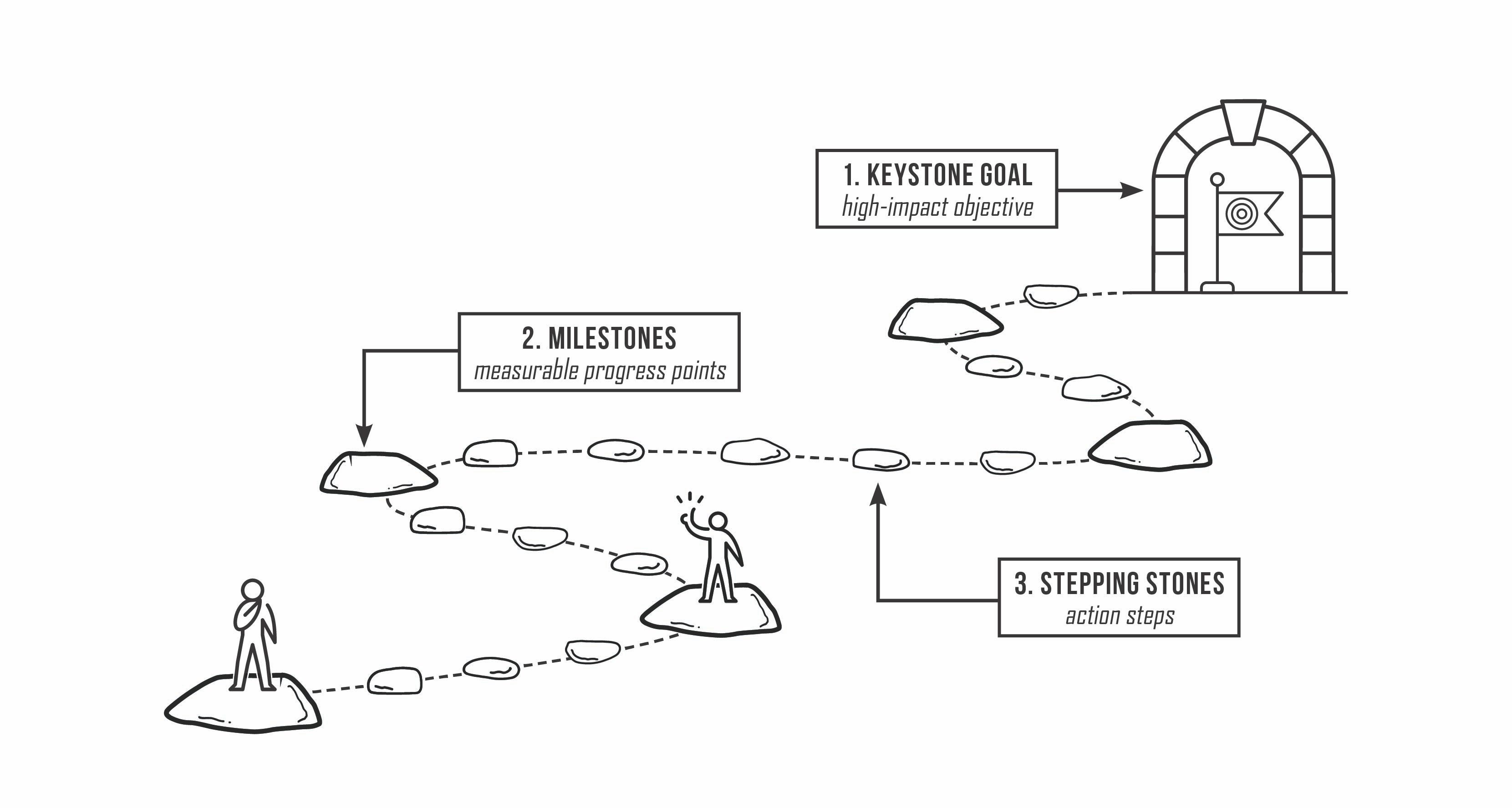
AND we need to establish actions that can help us arrive at base camp in the first place, so that we can then continue upward and onward to those camps above. At Behavior/Shift™, our process breaks down your Keystone Goals into what we refer to as Milestones and then Steppingstones. Think of Milestones as the camps you arrive at on the way to the summit and steppingstones as what it takes to put one foot in front of the other and get from camp to camp.
Proximal Goals: The Key to Progress
These ideas are strongly supported by classic research on self-regulation and proximal goals. In a 1981 study published in the Journal of Personality and Social Psychology, Albert Bandura and Dale Schunk examined how different types of goals affected learning, motivation, and confidence in elementary school children (this is a really good read!).
The researchers compared three groups:
- Proximal goals, where children worked toward small subgoals each session
- Distal goals, where children were given a single long-term target
- No specific goals, where children were simply told to work productively
The results were striking. Children who used proximal goals (sub goals) showed faster skill mastery, higher self-efficacy, and greater intrinsic interest in the task. In contrast, having only a distant goal produced no meaningful improvement over having no goal at all.
The takeaway is simple but powerful. Large goals do not motivate sustained effort on their own. Progress does.
The mountaineering analogy and the research point to the same conclusion. To achieve big Keystone goals, we need structured progress points that bring the goal within reach and clear steps defined to arrive at each progress point.
Milestones: Climbing above Base Camp
Milestones are your intermediary outcome goals on the path to your keystone – a progress point of achievement that shows you are getting closer to your goal. Think of them as the camps below the peak, those up on the mountainside itself. They break your Keystone goal into manageable chunks and help you measure progress and celebrate achievement.
Psychologists studying goal pursuit - people like Gary Latham, Teresa Amiable, Ayelet Fishbach, and others - have shown repeatedly that motivation depends on perceived progress. When a goal feels too distant, our brains treat it like a foggy horizon: inspiring at first glance, but impossible to navigate.
That’s why breaking your Keystone goals into smaller, concrete pieces isn’t just a “nice to have” – it’s critical to succeeding. Behavioral science explains why milestones are so powerful in goal pursuit. Research on the goal gradient effect, first observed by Hull in 1932 (with mice) and later confirmed in modern studies by Kivetz, Urminsky, and Zheng in 2006 (with humans), shows that both animals and people naturally increase their effort as they perceive themselves getting closer to a goal.
Complementing this, Teresa Amabile and Steven Kramer’s work on The Progress Principle demonstrates that even small wins generate positive emotions, which in turn fuel continued motivation. Together, these findings highlight that breaking big goals into tangible milestones, not only clarifies the path forward, but also keeps momentum and motivation high along the way.
Milestone goals are the waystations (camps) on the Keystone Goal trail. These are the points along the journey where you look back and say, “Hey, I’m actually getting somewhere.”
Milestones reduce our sense of being overwhelmed, build momentum, and make goal progress tangible.
For example:
If your Keystone goal is running a marathon (your summit), your milestones (camps) might be:
- Complete a marathon action plan – e.g., timeline, weekly training schedule, and health (sleep, nutrition, etc.) (Base Camp)
- Run a 5K (Camp 1)
- Run a 10K (Camp 2)
- Run a half marathon (Camp 3)
- Complete a 20-mile run before starting “taper period” (Camp 4)
If your Keystone goal is writing a book (your summit) your milestones (camps) might be:
- Clarify the book’s core idea, audience, and structure (Base Camp)
- Complete a detailed outline (Camp 1)
- Draft 25–30% of the manuscript (Camp 2)
- Draft 60–75% of the manuscript (Camp 3)
- Finish the full first draft (Camp 4)
Milestones matter because progress perception is one of the strongest motivators identified in goal research. When you can see progress, you keep going.
Stepping-Stones: The Actions That Get You There
While milestones show where you’re headed, stepping-stones are the concrete effort goals that move you toward them. These repeatable actions reduce uncertainty, prevent procrastination, and make progress visible in the moment.
Behavioral science consistently shows that people stick with goals more effectively when effort goals are clear and scheduled. They shrink uncertainty, and with it, procrastination.
For the marathon example, initial stepping-stones might include:
- Select a training plan aligned to your current fitness level*
- Block training days and times on your calendar for the next 8–12 weeks*
- Establish non-negotiables for sleep, hydration, and nutrition*
- Find an accountability partner*
- Schedule a baseline fitness check or health assessment if needed*
- Map out your training routes for each mileage goal**
- Lay out running gear the night before each run**
- Track runs and recovery in a training app or journal**
*Travel to Base Camp **Getting from Base Camp to Camp 1
For the book example, initial stepping-stones might include:
- Write a one-sentence premise for the book*
- Define the primary audience and problem the book solves*
- Identify 3–5 core themes or messages*
- Review comparable books for positioning and scope*
- Block recurring writing time on your calendar*
- Draft chapter titles and one-paragraph summaries for each**
- Define the purpose and takeaway of every chapter**
*Travel to Base Camp **Getting from Base Camp to Camp 1
These small, actionable steps compound. Tiny wins create momentum. Before you know it, the intimidating goal starts to feel possible.
Stepping-stones become even more powerful when paired with implementation intentions. These are simple if–then plans that specify exactly when, where, and how an action will take place. For example, you might plan, “If it’s Sunday night, then I map my running routes,” or “If it’s Tuesday at 6am, then I put on my running shoes and head out the door.” Research shows this approach works: Peter Gollwitzer first described the effectiveness of implementation intentions in 1999, and a meta-analysis by Gollwitzer and Sheeran in 2006 confirmed that they significantly improve goal attainment.
Stepping-stones (especially when paired with implementation intentions) are where intention becomes action.
A Simple, Science-Backed Way to Break Your Keystone Goal Down
Here’s the practical framework that blends the research with what we’ve learned from hundreds of interviews on our partner podcast Behavioral Grooves:
- Start with your Keystone goal.
- Choose 2-6 Milestones.
- Identify the Stepping-Stones for each milestone.
- Anticipate obstacles – ask what’s going to get in my way?
- Celebrate your progress. Seriously – as we said on the milestones and steppingstones episode of the Behavior Shift Show: give yourself a high five. Literally, a real one. Recognition reinforces motivation, and achieving a milestone deserves to be noticed.
Let’s bring this home with a real example
Keystone Goal (Summit): Run a marathon by the end of 2026
Milestone 1 (Arrival at Base Camp): Create a marathon action plan
Stepping-stones:
- Choose a target race and confirm the race date
- Select a training plan aligned to your current fitness level
- Block training days and times on your calendar for the next 8–12 weeks
- Establish non-negotiables for sleep, hydration, and nutrition
- Schedule a baseline fitness check or health assessment if needed
Milestone 1 (Camp 1): Run a 5K
Stepping-stones:
- Run 3–4 times per week at conversational pace
- Gradually increase weekly mileage by no more than 10 percent
- Map and pre-plan all weekly routes in advance
- Lay out running gear the night before each run
- Track runs and recovery in a training app or journal
Milestone 3 (Camp 2): Run a 10K
Stepping-stones:
- Add one longer run each week, increasing distance incrementally
- Introduce one light speed or tempo session per week
- Practice fueling and hydration during longer runs
- Schedule at least one active recovery or rest day per week
- Adjust training plan based on fatigue or early warning signs
Milestone 4 (Camp 3): Run a Half Marathon
Stepping-stones:
- Extend long runs to 10–12 miles
- Practice race-day pacing on long runs
- Test nutrition strategy under race-like conditions
- Schedule runs with an accountability partner or group
- Refine recovery routines including stretching and mobility
Milestone 5 (Camp 4): Complete a 20-Mile Run (Pre-Taper)
Stepping-stones:
- Plan 1–2 peak long runs at or near race pace segments
- Simulate race morning routines during long runs
- Lock in footwear, gear, and nutrition choices
- Reduce non-essential commitments during peak training weeks
- Begin taper plan and recovery focus immediately after peak run
Each stepping-stone builds capability and provides actionable progress. The more complex the Keystone, the more milestones, steppingstones, and even “sub-stepping-stones” you may need.
Each milestone increases confidence. Before long, the “big, hairy, audacious” Keystone goal no longer feels impossible.
This is how you move from “I want to do this” to “I can do this.”
Breaking down big goals isn’t busy work. It’s how you actually achieve the things that matter most. It reduces overwhelm, increases clarity, and builds the kind of progress that fuels motivation.
Keep taking those small steps toward your big dreams.
Keep moving forward.
And keep on shifting.
This Week’s Shift
A weekly reminder to rethink, reflect, and act:
Where do you need a clearer plan so progress doesn’t depend on motivation alone?
Listen
Go deeper into this week’s topic:
Thoughtful Reads
Curated ideas to inspire reflection:
The Vulture Edition - On ecosystems, disruption, and knock-on effects
Join us on Substack. Every week in Behavior Shift Weekly, we share ideas grounded in behavioral science and psychology, practical tools to help you think differently, act intentionally, and build the life you actually want.