
There is a particular kind of decision that should not take much out of us, but somehow does.
- Where should we go for dinner?
- Which Airbnb should we book?
- What should I wear to the party?
- Should I try a new hairstyle?
- Which notebook, water bottle, suitcase, hotel, podcast microphone, or laptop bag should I buy?
Unlike critical decisions or tricky decisions none of the decisions on the list are likely to redirect the course of your life. You probably won’t look back 20 years from now and say, “Everything changed when I selected the navy carry-on instead of the charcoal one.” And yet, these choices can swallow shocking amounts of time and mental energy.
You open a browser with the innocent intention of finding a decent hotel. Forty-seven tabs later, you are comparing neighborhood walkability, pillow quality, cancellation policies, user-generated photos, breakfast reviews, and whether “charming” secretly means “tiny and weird.” What began as a simple choice has become a full cognitive excavation.
This is the world of Satisficing Decisions.
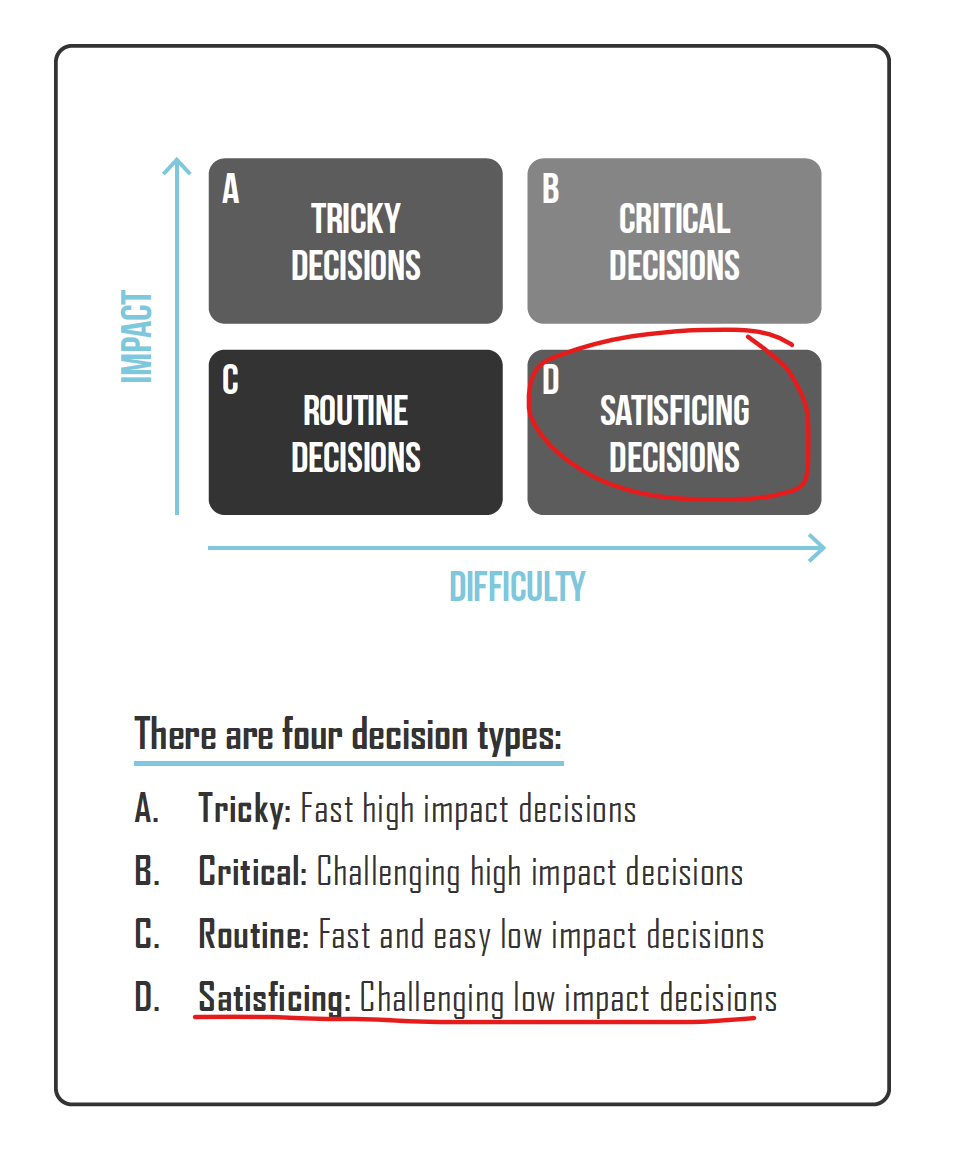
In the Decision/Shift model, Satisficing Decisions are low impact but high difficulty. The long-term stakes are usually modest, but the decision feels effortful, complex, or emotionally loaded. They are the choices that can trick us into spending premium brainpower on economy-class consequences.
And to understand why that happens, we need to go back to Herbert Simon.
Herbert Simon and the Freedom of “Good Enough”
In the 1950s, one of our favorite social scientists, Herbert A. Simon, challenged the idea that human beings make decisions like perfect little optimization machines. Classical economic models often assumed that people evaluate all available options, compare them rationally, and select the one that maximizes utility. Simon thought this was elegant, but unrealistic.
Humans, he argued, are boundedly rational. We make decisions with limited time, limited information, limited attention, and limited computational capacity. We do not always find the best possible option. Often, we search until we find an option that clears an acceptable threshold. Then we stop.
Simon called this satisficing, a blend of “satisfy” and “suffice.”
That word sounds like settling, but it is actually a deeply humane insight. Satisficing recognizes that decision-making has costs. Searching, comparing, analyzing, second-guessing, and optimizing all consume time and energy. At some point, the value of finding a slightly better option is outweighed by the cost of continuing to search.
This is especially true for Satisficing Decisions. If you are choosing a major medical treatment, optimizing may be worth it. If you are choosing toothpaste, it probably is not. The trick is knowing which kind of decision you are facing.
That is harder than it sounds, because modern life is designed to make small decisions feel big.
When Choice Becomes a Burden
Choice feels good in theory, most of us like having options. We want flexibility, personalization, and the freedom to pick what fits us best. A world with only one cereal, one vacation destination, one shirt, and one streaming show would be efficient, but bleak.
But more choice is not always better choice.
Sheena Iyengar and Mark Lepper’s famous research on choice overload helped show this. In one study, shoppers encountered either a large display of jams or a smaller display. More people were attracted to the large display, but people were more likely to actually purchase when the selection was smaller. The big choice set grabbed attention. The smaller choice set made action easier.
That is the tension at the heart of Satisficing Decisions. We like options until the options become work.
Later research has complicated the choice overload story. The effect does not appear equally in every context. Sometimes more choice is energizing. Sometimes it is exhausting. Researchers such as Alexander Chernev, Ulf Böckenholt, and Joseph Goodman have argued that choice overload depends on factors such as how complex the options are, whether people have clear preferences, how difficult it is to compare alternatives, and how much effort the decision requires.
That nuance matters. The problem isn’t choice itself, it’s choice without a stopping rule.
When we do not know what “good enough” looks like, every option becomes a doorway to another option. We compare and compare and compare, hoping for certainty. But for many low-impact decisions, certainty never arrives. There is always one more review, one more rating, one more Reddit thread, one more friend to ask, one more “Top 10” list promising clarity and delivering more tabs.
The Maximizer’s Trap
Some people are especially vulnerable to Satisficing Decisions because they are maximizers. Barry Schwartz and colleagues studied the difference between maximizers and satisficers. Maximizers try to make the best possible choice. Satisficers look for an option that meets their standards and then move on.
Maximizing sounds admirable. Who doesn’t want the best? But the research found that people with stronger maximizing tendencies often reported lower happiness, optimism, self-esteem, and life satisfaction, along with more regret and comparison.
This makes intuitive sense. If your goal is to find the best, then every decision becomes haunted by the possibility that something better exists. The hotel you booked might be good, but was there a better one? The restaurant was fun, but did you miss the hidden gem? The outfit looks fine, but was there one that would have made you look more interesting, more stylish, more like the person you wish you were?
Maximizing can be useful when the stakes justify the effort. If you are choosing a college, hiring a key employee, selecting a surgeon, or making a major financial decision, the extra effort may be wise. But when we maximize low-impact decisions, we burn mental fuel on choices that do not deserve the burn.
This is why satisficing is not a lowering of standards. It is a smarter allocation of attention.
Why Satisficing Decisions Feel Harder Than They Are
Satisficing Decisions are strange because they sit in a gap between actual importance and felt importance. The decision may be low impact, but it still touches things we care about: identity, taste, belonging, status, comfort, money, social approval, or the fear of regret.
What should I wear to the party? On the surface, low stakes. But underneath, the decision may carry social meaning. Will I look confident? Will I fit in? Will I look like I tried too hard? Will people judge me?
Where should we go on vacation? Again, maybe not life-altering. But underneath, there may be pressure to create memories, justify the cost, please multiple people, and avoid disappointment. The difference between France and Italy may not reshape your life, but the desire to make the “right” choice can still feel heavy.
Several biases can make these decisions more draining. Status quo bias can pull us toward the familiar, even when we want something different. Confirmation bias can lead us to search for evidence that supports the option we are already leaning toward. The sunk cost fallacy can keep us researching long after the research has stopped being useful because we feel we have already invested too much time to quit. Cognitive overload can make us feel foggy, frustrated, and unable to choose at all.
At some point, we are no longer improving the decision. We are just feeding the decision.
Optimize Selectively
The first strategy for navigating satisficing decisions is to optimize selectively.
Some low-impact decisions deserve more effort because they are personally meaningful. A vacation may not change your long-term life trajectory, but if it is a rare trip with your family, a long-awaited celebration, or something you have saved for, then by all means put care into it. Satisficing does not mean being careless. It means matching effort to value.
The key is to decide ahead of time whether this is a decision worth optimizing. If it is, give yourself permission to research, compare, and think carefully. But define the process. Set a deadline. Name the criteria. Decide who gets input. Otherwise, optimization can quietly become an endless search for emotional certainty.
A good question is: “Will additional effort meaningfully improve the outcome, or am I just trying to reduce discomfort?”
That question separates useful analysis from anxious analysis.
Satisfice Intentionally
The second strategy is to satisfice intentionally.
Before you start searching, define what “good enough” means. For a hotel, it might be: safe neighborhood, within budget, clean reviews, free cancellation, and close to the event.
Once an option meets those criteria, book it. For a restaurant, it might be: open at the right time, within 15 minutes, has something everyone can eat, and has decent reviews. Once it clears the bar, stop.
This is the most important part: the stopping rule has to come before the search.
Without a stopping rule, your brain will keep moving the finish line. You will start with “I just need a decent place to stay” and somehow end with “But what if there is a boutique hotel with better natural light and a rooftop breakfast situation?” That is not decision-making. That is recreational optimization disguised as responsibility.
Satisficing intentionally means saying: “I know this decision could be optimized forever, but it does not need to be. I am choosing a good-enough option because my time, attention, and peace of mind matter too.”
Use Rules to Protect Your Brain
Rules are underrated decision tools. They remove friction from choices that do not deserve a custom debate every time.
You might create rules like:
- For everyday purchases under a certain dollar amount, I choose the first option that meets my criteria.
- For restaurants, I check three options and pick one.
- For clothes, if I feel good in it and it fits the occasion, I stop changing.
- For travel lodging, I set a time limit of 30 minutes unless the trip is unusually important.
- For online reviews, I read enough to identify recurring patterns, not enough to absorb every stranger’s anxiety.
These rules may feel restrictive, but they are often liberating. They protect you from the illusion that every choice needs to be handcrafted from scratch. They also preserve mental energy for the decisions that truly deserve your best thinking.
Done Can Be Better Than Perfect
The deeper lesson of Satisficing Decisions is not that we should care less about life. It is that we should care more carefully.
Your attention is finite. Your decision energy is finite. Your time is finite. Spending those resources on one decision means not spending them somewhere else. When we over-optimize low-impact choices, we may feel responsible, but we are often just misallocating effort.
Sometimes the best decision is not the best possible option. Sometimes the best decision is the one that meets your needs and gives you your life back.
That is the beauty of satisficing. It gives us permission to stop when stopping is wise. It reminds us that not every choice deserves perfection. Some choices deserve a clear standard, a reasonable search, and the courage to move on.
Because sometimes “good enough” is not settling.
Sometimes “good enough” is the smartest choice in the room.
Keep Shifting,
Ready to take your decision making to the next level? Try our Decision Shift Behavior Change Guide today. Use code SUBSTACK10 for 10% off at checkout.
This Week’s Shift
A weekly reminder to rethink, reflect, and act:
Think about a Satisficing Decision that you tend to overthink.
Ask yourself: What can I do so that I’m not overthinking these types of decisions and that I can move on with my life?
Is it setting up rules in advance? Making the decision time bound? Limiting the options I can choose from? Think about what it would take to be better at this.
Listen
Go deeper into this week’s topic:
Thoughtful Reads
Curated ideas to inspire reflection:
- The Power of Writing by Hand
- Why Constraints are Good for Innovation
- Steve Martin and the Goldilocks Rule
Every week in Behavior Shift Weekly, we share ideas grounded in behavioral science and psychology, practical tools to help you think differently, act intentionally, and build the life you actually want.
References
- Chernev, A., Böckenholt, U., & Goodman, J. K. (2015). Choice overload: A conceptual review and meta-analysis. Journal of Consumer Psychology, 25(2), 333-358.
- Iyengar, S. S., & Lepper, M. R. (2000). When choice is demotivating: Can one desire too much of a good thing? Journal of Personality and Social Psychology, 79(6), 995-1006.
- Schwartz, B. (2004). The Paradox of Choice: Why More Is Less. Ecco.
- Schwartz, B., Ward, A., Monterosso, J., Lyubomirsky, S., White, K., & Lehman, D. R. (2002). Maximizing versus satisficing: Happiness is a matter of choice. Journal of Personality and Social Psychology, 83(5), 1178-1197.
- Simon, H. A. (1955). A behavioral model of rational choice. The Quarterly Journal of Economics, 69(1), 99-118.
- Simon, H. A. (1956). Rational choice and the structure of the environment. Psychological Review, 63(2), 129-138.
- Simon, H. A. (1978). Rational decision-making in business organizations. Nobel Prize Lecture.