
It was January 2024, and my wife and I (Ben) were standing at a crossroad.
Within a few short weeks, our lives had changed dramatically. We had adopted a dog and learned we were expecting our first child. Excitement and gratitude were mixed with something else: the realization that the life we had been building was about to change.
For years, we had prioritized flexibility and adventure. We lived in a camper, traveled, drove to Alaska, and built a life that allowed us to say “yes” to opportunities as they came. Now, we found ourselves back home in Boulder, CO living in our 900 square foot condo with one lofted bedroom and baby on the way.
Suddenly, 900 square feet felt a lot… smaller.
The open bedroom raised questions about midnight feedings and nap schedules. The lack of a yard seemed less ideal with a dog and a future toddler. Storage, which hadn’t mattered as much before, became impossible to ignore as we imagined all the gear that accompanies parenthood.
At the same time, another dream was waiting in the background.
A few years earlier, we had purchased a small piece of mountain property near the outdoor activities we loved. The plan was simple: save aggressively, build our dream home, and eventually make the move.
The problem was… we weren’t quite there yet, which left us caught between two competing futures.
We could stay in the condo and continue accelerating toward the mountain dream which was likely to still be years away. Or we could buy a modest home locally, giving our growing family more space but delaying the larger goal we had been working toward.
Neither option was obviously wrong, and neither option was obviously right. That’s what made it a Critical Decision — a challenging high impact decision on the decision quadrant.
The stakes were high, the tradeoffs were real, and the future was uncertain.
Would the housing market crash? Would business continue to grow? Would we regret delaying our long-term dream? Or would staying create unnecessary stress during one of the most important transitions of our lives?
We ran scenarios, talked to friends and family, and debated the probabilities and outcomes. Eventually, after careful consideration, we decided to buy a home locally and continue saving toward the mountain property.
Was it the “right” decision? The honest answer is that we don’t know. The results of the alternate path is a mystery.
What we do know is that it wasn’t a careless decision. It reflected our values, accounted for the information we had available, and acknowledged the uncertainty we couldn’t control.
And that may be the most important lesson about Critical Decisions: the goal isn’t certainty. The goal is making the best decision you can with incomplete information.
Not sure what category a decision you’re facing falls into?
Use this FREE decision quadrant exercise to identify it.
Why Critical Decisions Feel So Heavy
Our story isn’t unique. Most Critical Decisions feel this way.
Whether it’s choosing a career, getting married, buying a home, starting a business, moving across the country, or deciding whether to have children or not, these decisions arrive carrying significant consequences and no shortage of uncertainty. They shape the trajectory of our lives, yet they rarely never come with enough information to know exactly what the future holds.
That uncertainty is what makes them so difficult. The challenge isn’t that Critical Decisions are impossible to make. It’s that they matter, and because they matter, we desperately want to get them right. We want certainty in situations where certainty simply doesn’t exist.
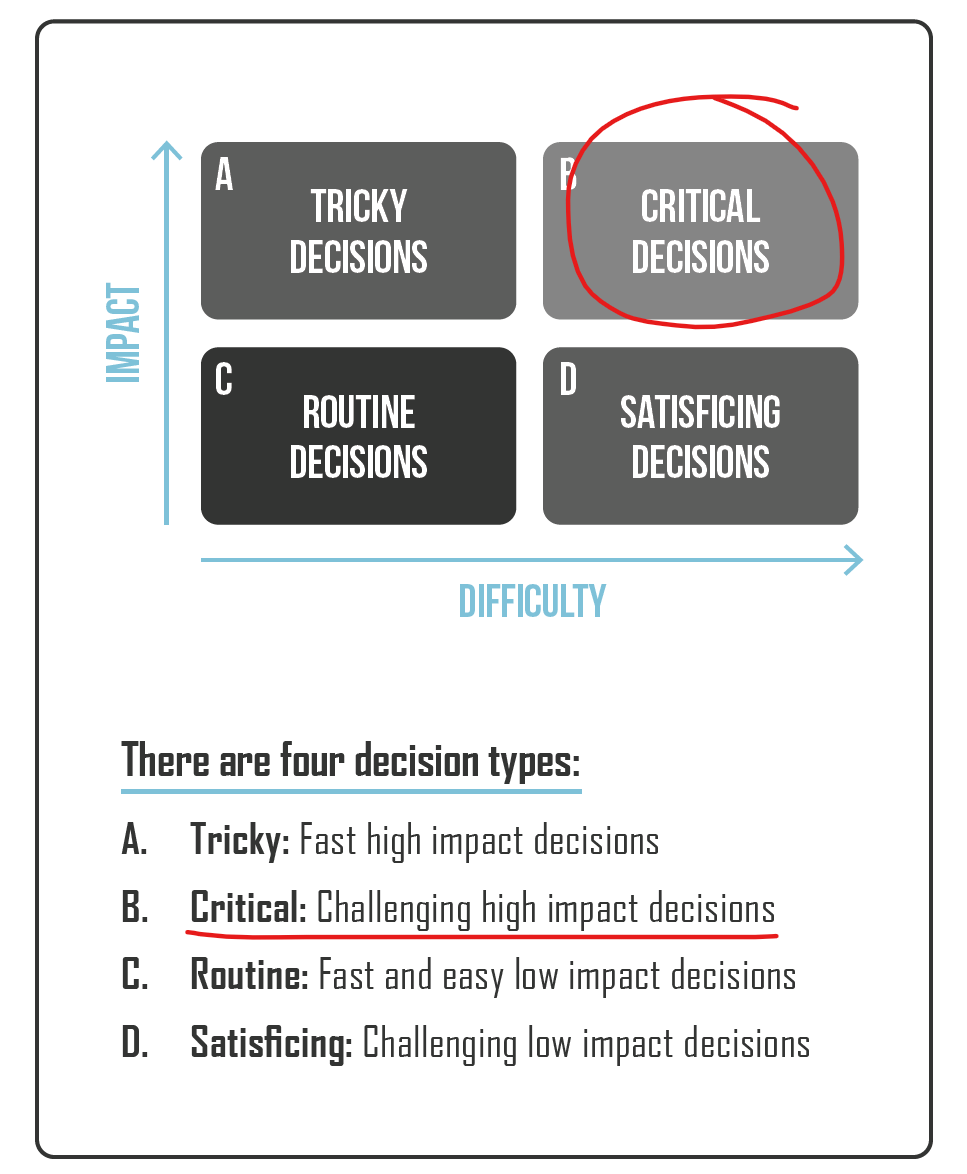
Unlike routine decisions, Critical Decisions don’t happen often enough for us to develop deep expertise through repetition. Most people don’t buy dozens of homes, launch ten businesses, or repeatedly navigate major life transitions. The opportunities to learn from experience are limited, which means we often find ourselves navigating some of life’s most important choices without a compass.
That reality creates a tremendous amount of pressure. The higher the stakes, the more we feel responsible for predicting a future that cannot be fully known and the more overwhelmed we may feel.
This is why Critical Decisions can feel so exhausting. It’s not simply that they are important. It’s that they require us to mentally live through multiple possible futures before choosing one.
Behavioral scientists often refer to cognitive load, the amount of mental effort required to process information and make decisions. Critical Decisions demand a tremendous amount of it. We weigh competing priorities, imagine future scenarios, estimate risks, evaluate trade-offs, and attempt to forecast outcomes years into the future. The result is often stress, rumination, and decision fatigue.
When the Brain Starts Looking for Shortcuts
Ironically, the decisions that deserve the most careful thinking are often the ones where our brains become most vulnerable to bias.
When uncertainty rises, our minds naturally look for ways to reduce discomfort. Sometimes that means avoiding the decision entirely, other times it means convincing ourselves that we already know the answer.
One of the most powerful shortcuts at work is motivated reasoning. Motivated reasoning occurs when we evaluate evidence not based on what is most accurate, but on what supports the conclusion we already want to reach.
Perhaps we want the bigger house because it feels exciting. Maybe we want the prestigious job because it validates our identity. Perhaps we want to start the business because we’ve already told everyone we’re going to do it. This can lead us to make decisions that end up not being in our best long-term interest.
Instead of asking, “What does the evidence suggest?” we begin asking, often unconsciously, “How can I support the outcome I prefer?”
Motivated reasoning is closely aligned and reinforced by confirmation bias. Once we begin leaning toward a particular option, our brains naturally seek information that supports it while overlooking information that challenges it. We read articles that validate our position. We seek advice from people who think like we do. We become lawyers defending a case rather than investigators seeking the truth. The worst part is that this is done at a subconscious level which means our brains are doing it and we don’t even realize it.
Another common trap is status quo bias. Humans are naturally resistant to change. Even when a new option may better align with our goals or values, the familiarity of our current situation can feel safer. The known problems of today often feel less intimidating than the unknown possibilities of tomorrow. There is less uncertainty, which our brains crave – which again can make us choose the lesser option.
Finally, there is cognitive overload. When decisions involve too many variables, too many possibilities, or too much information, our brains can simply become overwhelmed. Ironically, this often leads us to default to the easiest option rather than the best one.
Understanding these biases doesn’t eliminate them. It does, however, give us a chance to recognize when they might be quietly influencing our thinking.
How to Approach a Critical Decision
The goal of a Critical Decision is not to eliminate uncertainty. That isn’t possible.
The goal is to build enough confidence in your decision-making process that you can move forward despite uncertainty.
That process begins with slowing down.
Unlike the Tricky Decisions we discussed last week, Critical Decisions should rarely be rushed. Tricky Decisions require speed bumps; Critical Decisions require space.
Giving yourself time creates distance between emotion and analysis. It allows new information to emerge, competing options to be explored, and assumptions to be challenged. Slowing down doesn’t guarantee a better decision, but it dramatically increases the likelihood that you’re making the decision intentionally rather than reactively (and hopefully avoiding the biases we discussed).
The second step is widening your lens.
One of the easiest mistakes to make during a Critical Decision is becoming fixated on a single option. When that happens, we begin evaluating whether that option will work instead of asking whether another option might work better.
This is where structured decision-making tools become useful.
A SWOT Analysis forces us to examine both the strengths and weaknesses of a decision, along with the opportunities and threats that surround it. Rather than focusing exclusively on what could go right, it encourages us to think carefully about what could go wrong.
A Weight and Rate analysis can be especially valuable when comparing multiple options. Instead of relying solely on intuition, it requires us to identify the criteria that matter most and assign them relative importance. We then evaluate each option against those criteria.
The exercise isn’t powerful because it produces a perfect answer. It’s powerful because it forces clarity about what matters most.
Decision Trees offer another valuable perspective. Most decisions don’t have a single outcome. They have multiple possible outcomes, each with different probabilities.
A decision tree forces us to move beyond simplistic thinking. Rather than asking, “Will this work?” we begin asking, “What are the most likely outcomes, and how likely are they to occur?”
This shift toward probability thinking is important because life rarely unfolds in absolutes. Most major decisions exist somewhere between certainty and impossibility.
In our own housing decision, we couldn’t know whether the market would rise or fall, whether business would thrive or slow, or whether our mountain-home timeline would accelerate or delay. What we could do was think carefully about the most probable scenarios and determine which path gave us the best chance of achieving what mattered most.
The Courage to Decide
Eventually, every Critical Decision reaches the same point.
The analysis is complete, the conversations have happened, the pros and cons have been debated, and the research has been gathered.
And yet uncertainty remains. This is where many people get stuck.
Psychologically, it is tempting to believe that one more article, one more conversation, or one more week of thinking will finally provide the certainty we’ve been looking for. Most of the time, it doesn’t.
At some point, the challenge shifts from analysis to courage.
Decision scientist Annie Duke frequently reminds us that a good decision and a good outcome are not the same thing. A thoughtful decision can still produce an unfavorable result, and a careless decision can occasionally work out well.
This distinction matters because we often judge decisions based entirely on how things turn out. But outcomes are influenced by factors beyond our control. Decision quality is not.
A good Critical Decision reflects your values. It accounts for the available evidence, acknowledges uncertainty, and considers probabilities and trade-offs. It challenges assumptions and explores alternatives.
After that, there is always an element of uncertainty that must simply be accepted.
Returning to our story, I still don’t know whether buying our home was the objectively “right” choice. There is no alternate timeline available for comparison. What I do know is that the decision reflected our values, incorporated the information we had available, and considered the risks we could reasonably foresee.
That’s all any of us can really do.
The goal isn’t certainty, the goal is making the best decision possible with incomplete information and then having the courage to move forward.
You don’t need certainty to move forward.
You need a process you trust.
And, of course, keep on shifting,
Ready to take your decision making to the next level? Try our Decision Shift Behavior Change Guide today. Use code SUBSTACK10 for 10% off at checkout.
This Week’s Shift
A weekly reminder to rethink, reflect, and act:
Think about a Critical Decision you’re currently facing or one that may be approaching.
Ask yourself: Am I trying to eliminate uncertainty, or am I trying to improve my decision process?
Then identify one action that would strengthen your process this week. Maybe it’s seeking a different perspective, creating a decision tree, or finally writing down the criteria that actually matter.
Listen
Go deeper into this week’s topic:
Thoughtful Reads
Curated ideas to inspire reflection:
- Music’s power over our brains
- 5 principles of organizational communication
- Incentives and the supreme court
Every week in Behavior Shift Weekly, we share ideas grounded in behavioral science and psychology, practical tools to help you think differently, act intentionally, and build the life you actually want.
References
- Duke, A. (2018). Thinking in Bets: Making Smarter Decisions When You Don’t Have All the Facts. Portfolio.
- Kahneman, D. (2011). Thinking, Fast and Slow. Farrar, Straus and Giroux.
- Tversky, A., & Kahneman, D. (1974). Judgment under uncertainty: Heuristics and biases. Science, 185(4157), 1124-1131.
- Kunda, Z. (1990). The case for motivated reasoning. Psychological Bulletin, 108(3), 480–498.
- Samuelson, W., & Zeckhauser, R. (1988). Status quo bias in decision making. Journal of Risk and Uncertainty, 1, 7–59.
- Sweller, J. (1988). Cognitive load during problem solving: Effects on learning. Cognitive Science, 12(2), 257–285.