
Some decisions deserve a long walk, a spreadsheet, and a brutally honest conversation with someone who knows you well. Others deserve about seven seconds or less. The problem is that we often confuse the two.
We overthink what to order for dinner but then rush into a commitment that reshapes our calendar, our bank account, or our relationships without a pause to reflect. We spend 45 minutes reading reviews for a $19 purchase, then say yes to a work obligation that quietly consumes the next six months. Too often, we agonize over the tiny stuff and improvise the big stuff.
This is why the Behavior Shift Decision Quadrant is useful. It gives us a simple way to ask: What kind of decision am I actually making?
Grab your free copy of the Behavior Shift Decisions Quadrant Exercise here.
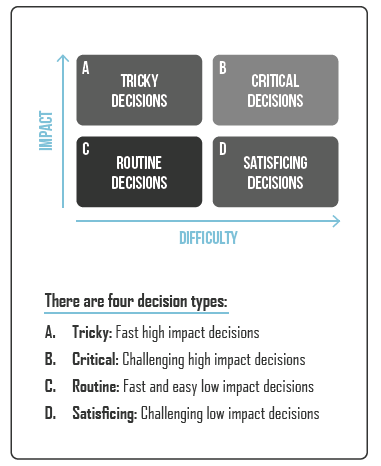
The model sorts decisions using two dimensions: impact and difficulty. Impact means the significance of the consequences. Difficulty means the amount of effort, time, uncertainty, complexity, or emotional weight involved in reaching a conclusion.
Put those together and you get four types of decisions: Routine, Tricky, Critical, and Satisficing.
The value of the quadrant is not that every decision fits perfectly into a box. It is that the act of sorting the decision helps us respond with the right amount of attention.
The Four Types of Decisions
A Routine Decision is low impact and low difficulty. What socks should I wear? Do I delete this spam email? What do I eat for breakfast? Most of these decisions are not worth deep reflection. In fact, the brain is built to automate them. Kahneman and Tversky’s work on heuristics showed that humans often rely on mental shortcuts to make judgments efficiently, especially under uncertainty (learn more – here). That is not a flaw. It is part of how we function.
But Routine Decisions become more important when they repeat. One bowl of ice cream, one skipped walk, one “quick check” of your phone may not matter much. However, repeated daily, these small choices compound into patterns that have an oversized effect on our lives.
A Tricky Decision is high impact but low difficulty. These are the decisions that feel easy in the moment but carry real consequences. Driving after a couple drinks. Quitting after a heated argument. Adopting the adorable puppy you saw online without thinking through time, cost, and care. These decisions are dangerous precisely because they do not feel hard. They often happen in hot emotional states, when our fast, automatic thinking is in charge.
A Critical Decision is high impact and high difficulty. These are the big ones: choosing a career path, buying a home, getting married, starting a business, making a major investment. These decisions deserve time, structure, and outside perspective. They also tend to be stressful because they involve uncertainty, tradeoffs, and identity. The stakes are high, and learning from past experience is often limited because we do not make these decisions very often.
A Satisficing Decision is low impact but high difficulty. These are the sneaky ones. They do not matter that much in the long run, but they can consume a surprising amount of mental energy. Where should we go on vacation? Which hotel is best? What should I wear to the party? Which new laptop bag should I buy? Herbert Simon introduced the idea of “satisficing” as part of bounded rationality, the recognition that humans do not optimize every decision because our time, knowledge, and cognitive capacity are limited. Instead, we often seek an option that is good enough.
Why the Quadrant Matters
The quadrant helps solve one of the biggest problems in decision-making: misallocated effort.
We sometimes treat low-impact decisions as if they require maximum optimization. This is the world of endless review-reading, tab-opening, and “just one more search.” Research by Sheena Iyengar and Mark Lepper famously showed that while more choice can attract attention, too many options can reduce action and satisfaction. In their “jam study”, two booths we set up. One contained twenty-four jam choices and the other had six. People were naturally drawn to a larger display and more shoppers visited it. But, while it attracted less shoppers, the people who visited the booth with six jam choices were significantly more likely to buy a jar of jam.
There is a distinction between maximizers and satisficers. Maximizers seek the best possible choice. Satisficers seek a choice that meets their standards. In research by Barry Schwartz, maximizing was associated with lower happiness, optimism, self-esteem, and life satisfaction.
This matters because “best” is expensive. Not just financially, but cognitively. Trying to make the perfect low-impact decision can drain the energy we need for decisions that actually shape our lives.
At the same time, we sometimes treat high-impact decisions as if they are routine. We go with what is familiar or we follow the crowd. We get pulled by scarcity, urgency, social pressure, or the emotional heat of the moment. Samuelson and Zeckhauser’s research on status quo bias showed that people often prefer the current or default option, even when alternatives may be better.
The quadrant helps us pause long enough to ask: Is this decision getting the amount of attention it deserves?
The Same Decision Can Belong in Different Quadrants
One of the most important parts of the Decision Quadrant is that the same decision can fall into different quadrants for different people.
Buying a car may be a Critical Decision for someone with limited financial flexibility, but closer to a Routine or Satisficing Decision for someone with abundant resources and deep knowledge of cars. Asking someone out may feel like a Tricky Decision for one person, but a Critical Decision for another depending on social context, confidence, history, and emotional stakes.
The quadrant is personal because decisions are personal. Our financial safety, social stability, personality, values, experience, and current stress level all change how a decision feels and what it means.
Even the same decision can move quadrants for the same person. Choosing a restaurant may be Routine on a normal Friday night, Satisficing when planning a group dinner, and Tricky if the dinner is with someone you desperately want to impress.
That is not a weakness of the model. That is the point.
How to Use the Quadrant
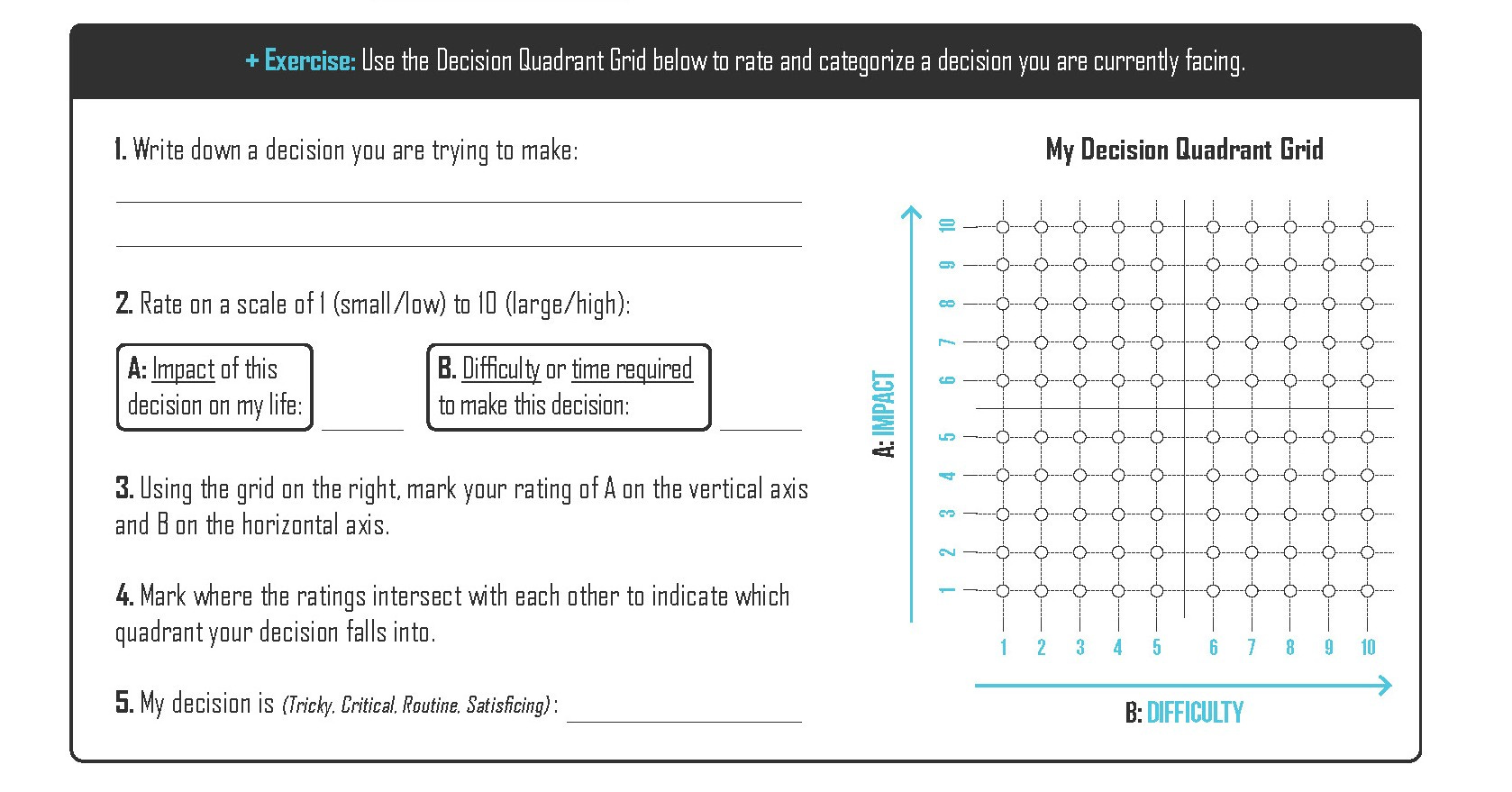
Before making a decision, ask two questions.
- First: How much impact could this have on my life, my goals, my relationships, my money, my health, or my future?
- Second: How difficult is this decision, based on time, complexity, uncertainty, emotional weight, and effort?
- Third: Map the intersection on the quadrant.
If the decision is Routine, do not overbuild the process. Use habits, defaults, or simple rules. Save your mental energy.
If it is Tricky, slow down. Add friction. Take a breath. Ask what future you will wish present you had considered.
If it is Critical, give it structure. Gather information. Define your values. Consider multiple options. Use tools like a decision tree, a weighted criteria grid, or a premortem. Gary Klein’s premortem method asks people to imagine that a decision has failed and then identify the reasons why, which can help reveal risks before commitment.
If it is Satisficing, set a standard and stop when you meet it. Decide what “good enough” means before you start searching. Then protect yourself from turning a low-impact decision into a high-effort spiral.
The Decision Shift Behavior Change Guide helps you put these decisions tools into action.
Use code SUBSTACK10 for 10% off at checkout.
The Real Goal: Better Decision Fit
A good decision is not always the one with the perfect outcome. Annie Duke makes this point well: decision quality depends on process, not just results. You can make a thoughtful decision and still get unlucky. You can make a sloppy decision and still have things work out.
The Decision Quadrant gives us a better process because it helps us match our effort to the decision in front of us.
Some decisions need more thought. Some need less.
Some need a pause because they are too easy to make quickly.
Some need a deadline because they are too easy to overthink.
The shift is simple: stop asking every decision to carry the same weight. Learn what kind of decision you are facing, then give it the kind of attention it deserves.
That is how we move from reacting to deciding.
And that is how small shifts become better choices.
Keep on Shifting,
Ready to take your decision making to the next level? Try our Decision Shift Behavior Change Guide today. Use code SUBSTACK10 for 10% off at checkout.
This Week’s Shift
A weekly reminder to rethink, reflect, and act:
Think of a decision you either overanalyzed or unanalyzed. Run it through the decision quadrant. What decision type is it?
Listen
Go deeper into this week’s topic:
Thoughtful Reads
Curated ideas to inspire reflection:
- How Unlucky People can Become Lucky
- Reading fiction can improve marketing
- How tension creates great stories
Every week in Behavior Shift Weekly, we share ideas grounded in behavioral science and psychology, practical tools to help you think differently, act intentionally, and build the life you actually want.
References
- Kahneman, D. (2011). Thinking, Fast and Slow.
- Tversky, A., & Kahneman, D. (1974). Judgment under uncertainty: Heuristics and biases. Science, 185(4157), 1124-1131.
- Simon, H. A. (1955). A behavioral model of rational choice. The Quarterly Journal of Economics, 69(1), 99-118.
- Simon, H. A. (1978). Rational decision-making in business organizations. Nobel Prize Lecture.
- Iyengar, S. S., & Lepper, M. R. (2000). When choice is demotivating: Can one desire too much of a good thing? Journal of Personality and Social Psychology, 79(6), 995-1006.
- Schwartz, B., Ward, A., Monterosso, J., Lyubomirsky, S., White, K., & Lehman, D. R. (2002). Maximizing versus satisficing: Happiness is a matter of choice. Journal of Personality and Social Psychology, 83(5), 1178-1197.
- Samuelson, W., & Zeckhauser, R. (1988). Status quo bias in decision making. Journal of Risk and Uncertainty, 1, 7-59.
- Klein, G. (2007). Performing a project premortem. Harvard Business Review.
- Duke, A. (2018). Thinking in Bets: Making Smarter Decisions When You Don’t Have All the Facts. Portfolio.