
What if the reason you’re not following through on the habits you care about… isn’t you?
In life, it’s easy to internalize the gap between intention and action as a personal failure. You decide to get more organized, to stay on top of follow-ups, to create space for deeper thinking, or to end each day with a sense of closure rather than carryover.
The intentions are real, and for a brief window—sometimes a few days, sometimes a week—you follow through. Then the week gets crowded. A meeting runs long, priorities shift, your energy dips just enough, and the behavior quietly disappears. Not because it didn’t matter, but because it asked for more than your environment could consistently support.
Behavioral science offers a different explanation, one that is both more precise and, in many ways, more forgiving.
Motivation x Ability x Prompting.
In studying how habits actually form in the real world, Social Scientist BJ Fogg found that behavior is not primarily a function of motivation or even intention. Instead, it emerges when three elements converge at the same moment: motivation, ability, and a prompt.
When any one of those elements is missing or weakened, the behavior doesn’t happen.
Most of us instinctively try to solve this problem by increasing motivation. We look for inspiration, recommit to our goals, or wait for a moment when we “feel ready.” But motivation is the most volatile part of the system.
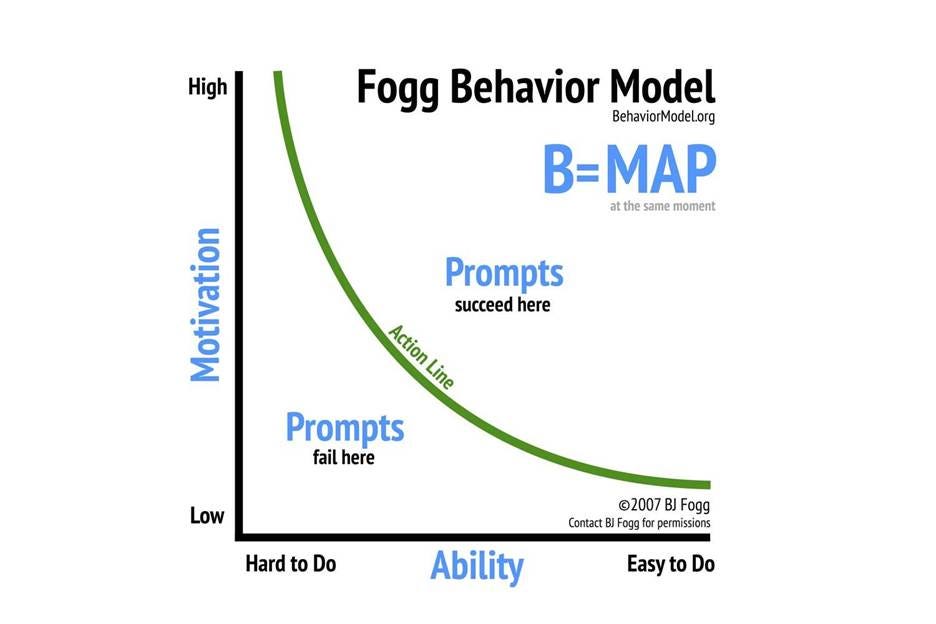
It fluctuates with sleep, stress, competing demands, and countless subtle contextual factors. It is, quite simply, unreliable.
Ability > Motivation
Fogg’s insight shifts the focus away from motivation and toward ability. Instead of asking how to care more or try harder, the question becomes: how can we make the behavior easier—so easy that it requires almost no effort to begin?
This is where the idea of tiny habits takes hold. A tiny habit is not a scaled-down version of a larger goal; it is a deliberately minimized behavior designed to remove friction almost entirely.
The idea is simple: make the behavior easier, radically easier.
So easy, in fact, that it feels almost pointless. For example:
- Write a single sentence at the end of each day
- Block one 15-minute window on your calendar every day for a brain break
- Drafting the first line of a follow-up email after a meeting
On the surface, these actions appear too small to matter. But their power lies not in their immediate impact, but in what they make possible over time.
Outcomes vs. Identity
To understand why this works, it helps to shift from thinking about outcomes to thinking about identity. Research in self-perception theory, developed by Daryl Bem, suggests that we infer who we are by observing our own behavior. We don’t become someone who reflects because we intend to; we become that person because we repeatedly engage in reflection, however small.
Each action, no matter how minor, serves as evidence. When you write a single sentence at the end of the day, you are not just capturing a thought, you are reinforcing the identity of someone who pays attention, who processes, who closes the loop.
Over time, that identity begins to carry its own momentum, making future actions feel less like effort and more like alignment.
There is also an emotional component that is often underestimated. We tend to think of habits as the product of repetition, but repetition alone is not enough.
The work of Teresa Amabile on the progress principle highlights how even small wins can significantly influence motivation and engagement. Progress, when it is felt, creates energy.
Tiny habits are uniquely suited to generate this feeling because they are designed to succeed. When the bar is set low enough that you can clear it consistently, you create a steady stream of small completions in a day that might otherwise feel fragmented or unfinished. That sense of completion, however brief, reinforces the behavior and makes it more likely that you will return to it.
Tiny Habits at Work
In a professional context, this approach can be both subtle and transformative.
Instead of attempting to redesign your entire workflow, you begin by embedding small actions into moments that already exist.
- When you open your laptop in the morning, you might block a single 15-minute window.
- When you finish a meeting, you write the first sentence of a follow-up email, reducing the likelihood that the task will linger or be forgotten.
- Before you close your laptop at the end of the day, you capture one sentence of reflection, creating a boundary between what happened and what comes next.
None of these actions are impressive on their own, and that is precisely why they work. They require so little effort that they can survive the variability of real workdays, showing up not only when motivation is high, but when it is absent.
Over time, these small actions begin to expand, but not through force.
- The one sentence becomes two.
- The single time block becomes a pattern of intentional planning.
- The first line of an email turns into a habit of closing conversations cleanly and consistently.
This expansion is not the result of discipline imposed from the outside, but of a system that has reduced friction to the point where continuation feels natural. What began as a tiny behavior becomes part of a broader rhythm, integrated into how you work rather than layered on top of it.
Ambition vs Consistency
There is a quiet challenge embedded in this approach, particularly for high-performing professionals. It asks you to redefine what counts as success. In environments that reward scale and visibility, it can feel counterintuitive—even uncomfortable—to set a goal that seems almost trivial.
But behavior change does not respond to ambition alone.
It responds to consistency, and consistency is built on actions that are small enough to be repeated without resistance. The irony is that what looks insignificant in the moment is often what proves most sustainable over time.
If there is a place to begin, it is not with a complete system or a sweeping change, but with a single behavior. Anchor it to something you already do, reduce it until it feels almost unnecessary, and allow yourself to register the completion when it happens. That moment of acknowledgment is not just a reward; it is part of the mechanism that makes the habit stick. Over time, these moments accumulate, forming patterns that are less about what you are trying to do and more about who you are becoming.
Behavior, like most meaningful things, does not transform all at once. It builds gradually, often below the level of immediate visibility, until the accumulation becomes undeniable.
The shift is not dramatic, but it is durable. And in the end, that is what most of us are actually looking for—not a burst of change, but a way of working that holds, even when the week gets real.
Keep on shifting - even if its tiny,
Stuck on your goals? Try our behavior change products. Use code SUBSTACK10 for 10% off at checkout.
This Week’s Shift
A weekly reminder to rethink, reflect, and act:
If you’ve ever been in a work rhythm where things flowed and felt meaningful, or stuck in the grind counting down the hours, we want your input.
We’re researching what helps people find their groove at work. Take 10 minutes to complete this survey: https://www.surveymonkey.com/r/VMP532X
Complete it and enter your email for a chance to win one of 25 free copies of Mindwise by Nicholas Epley.
![[Paperback] [Nicholas Epley] Mindwise: Why We Misunderstand What Others Think, Believe, Feel, and Want](https://substackcdn.com/image/fetch/$s_!OryB!,f_auto,q_auto:good,fl_progressive:steep/https%3A%2F%2Fsubstack-post-media.s3.amazonaws.com%2Fpublic%2Fimages%2Fa45f87ed-8e03-441c-8fbd-26e01e9e24b6_302x466.jpeg "[Paperback] [Nicholas Epley] Mindwise: Why We Misunderstand What Others Think, Believe, Feel, and Want")
Listen
Go deeper into this week’s topic:
Thoughtful Reads
Curated ideas to inspire reflection:
Writing by hand is better for memory
Every week in Behavior Shift Weekly, we share ideas grounded in behavioral science and psychology, practical tools to help you think differently, act intentionally, and build the life you actually want.
References
-
Fogg, B. J. (2019). Tiny Habits: The Small Changes That Change Everything. Boston: Houghton Mifflin Harcourt.
-
BJ Fogg Website: https://www.bjfogg.com/
-
Bem, D. J. (1972). “Self-Perception Theory.” Advances in Experimental Social Psychology. https://www.researchgate.net/publication/277682193_Self-Perception_Theory
-
Amabile, T. M., & Kramer, S. J. (2011). The Progress Principle: Using Small Wins to Ignite Joy, Engagement, and Creativity at Work. Boston: Harvard Business Review Press.
-
Amabile, T. M., & Kramer, S. J. (2011). “The Power of Small Wins.” Harvard Business Review. https://hbr.org/2011/05/the-power-of-small-wins
-
Gollwitzer, P. M. (1999). “Implementation Intentions: Strong Effects of Simple Plans.” American Psychologist, 54(7), 493–503. https://www.prospectivepsych.org/sites/default/files/pictures/Gollwitzer_Implementation-intentions-1999.pdf