
The smallest decisions may be the ones shaping your life more than you realize.
We often think that our life is shaped by the big, dramatic decisions. The career move, the house purchase, the difficult conversation, or the moment when everything feels like it is hanging in the balance.
Of course those decisions matter and they deserve a lot of attention. But much of life is built somewhere else, it’s built in the choices we barely notice.
- What do we habitually eat when we are rushed?
- Do we check our phone before we get out of bed?
- Do we open email before doing meaningful work?
- Do we take the stairs or the elevator?
- Do we pause before reacting, or do we answer in the same tone we received?
These are Routine Decisions: the small, everyday choices we make almost automatically. They are usually low in difficulty and low in immediate impact. Each one, by itself, may not seem to matter much. Choosing the same breakfast, taking the same route, scrolling the same app, or starting the day the same way probably will not redirect your life in one dramatic motion.
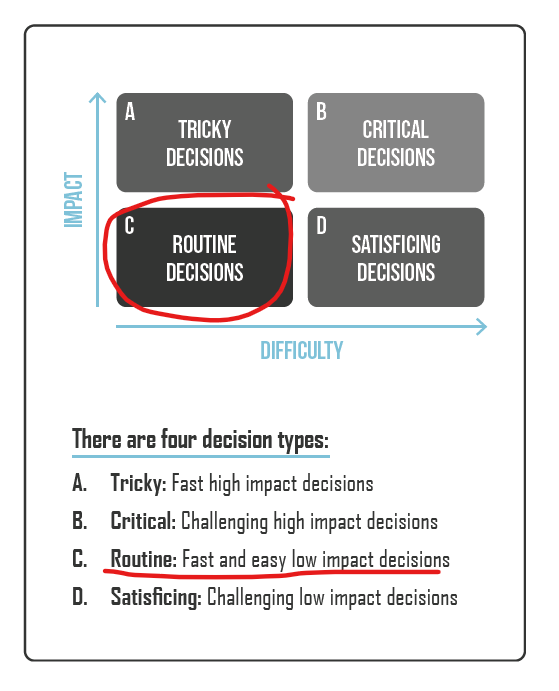
But Routine Decisions have something that the other decisions don’t - they repeat. And repeated choices have a way of becoming the architecture of your life.
Not sure what category a decision you’re facing falls into?
Use this FREE decision quadrant exercise to identify it.
The Decisions We No Longer Experience as Decisions
Routine Decisions are the choices we make because we’ve made them so many times before or because they are the simplest or easiest response. They live in the ordinary flow of the day: what we eat, what we wear, how we commute, when we check messages, how we respond to stress, and how we transition from one part of the day to the next.
At their best, routines are incredibly useful. They reduce cognitive load. They keep life moving. They allow us to conserve mental energy for more important problems. If you had to fully deliberate every morning over socks, toothpaste, breakfast, coffee, email, and your route to work, you would be exhausted before the real day began.
This is why the brain loves routine. A routine is a behavioral shortcut. Once a pattern is established, the environment starts doing some of the work. The coffee maker, the kitchen counter, the phone on the nightstand, the office chair, the 3 p.m. slump, and the couch after dinner can all become cues that trigger familiar responses.
Researchers David Neal, Wendy Wood, and Jeffrey Quinn describe habits as responses activated automatically by context cues that were paired with past behavior. In other words, habits are not just things we do often. They are things our environment helps us do again.
That is the power of routine.
The downside is that those same routines can also create risk. Because once a choice becomes automatic, we may stop asking whether it is still serving us.
The Problem is Not the Routine. It is the Drift.
Routine itself is not the enemy. Bad routine is.
Some of the best behaviors in life work best when they become routine. Exercise becomes easier when it is not a daily debate. Healthy eating becomes easier when better food is already available. Saving money becomes easier when the transfer is automatic. Focused work becomes easier when the phone is out of reach before the work begins.
The problem begins when routines drift away from our goals without our noticing.
No single routine choice may seem significant. But small automatic choices accumulate. They end up compounding – the small acts that by themselves don’t have a tangible impact on our lives, end up having an oversized impact when repeated constantly.
- Ice cream after dinner is a great treat every once and a while, when its every night though it can impact your health.
- The “quick phone check” becomes the first 40 minutes of every morning leaving you emotionally spent.
- The same defensive reply becomes the normal rhythm of a relationship.
This is the strange thing about Routine Decisions: they often feel too small to examine, but they are exactly the kind of decisions that compound. Not because any one of them is powerful, but because they are repeated.
Phillippa Lally and colleagues studied habit formation in everyday life by asking people to repeat a chosen eating, drinking, or activity behavior in the same context over 12 weeks. Their research showed that automaticity develops gradually through repetition in stable contexts, although the timeline varies widely depending on the person and the behavior.
That finding matters because routine is not just repetition. Routine is repetition plus context. It is the repeated link between a situation and a behavior.
- When I finish breakfast, I take my vitamins.
- When I sit at my desk, I open my planning document first.
- When I feel the urge to react sharply, I take three breaths before responding.
These small links reduce the need for constant decision-making. They help us become the kind of person who does certain things without needing to wrestle ourselves into doing them every time.
Defaults Are Decisions You Made Earlier
One of the best ways to understand Routine Decisions is to think of them as defaults. A default is what happens when you do nothing new.
- If your phone is beside your bed, checking it may become the default.
- If the chips are on the counter, snacking may become the default.
- If your calendar has no protected focus time, reacting to other people’s priorities may become the default.
Defaults are powerful because they reduce friction. Accepting the default is easy, changing it takes effort. The easier path gets chosen more often.
So, the question is not simply, “What do I want to do?” The better question is, “What have I made easy to do?”
The Goal Is Not Mindful Everything
A common response to Routine Decisions is to say we should be more mindful. That is partly true. Mindfulness matters. Pausing matters. Noticing matters.
But the goal is not to turn every Routine Decision into a reflective essay. You do not need to contemplate the existential meaning of oatmeal. You do not need to perform a values audit every time you choose a shirt. You do not need to pause at every doorway and ask, “What kind of human am I becoming?”
That would be exhausting.
The goal is not mindful everything. The goal is selective awareness.
Most Routine Decisions should remain routine. Some routines are working beautifully. Leave them alone. Some are neutral and not worth much attention. But some are quietly pulling you away from the person you want to become.
Those are the routines to examine.
The question is: Which small repeated choices are producing outcomes I no longer want?
That is where the work begins.
Upgrade the Routine, Not the Whole Life
When people try to change their behavior, they often aim too broadly. They decide to become healthier, more focused, more patient, more disciplined, more organized, more present, or more intentional.
Those are worthy aspirations. But they are too large to act on in the moment.
Routine Decisions give us a more practical target. For example, instead of starting with “I need to become healthier.”
- Start with breakfast.
- Start with the grocery list.
- Start with what is visible on the counter.
- Start with what you do when you feel tired at 3 p.m.
Or, instead of starting with “I need to be more focused.”
- Start with the first 10 minutes of the workday.
- Start with where your phone lives.
- Start with whether email opens before or after your most important task.
And, instead of starting with “I need to be more patient.”
- Start with the first sentence you say when you feel irritated.
- Start with the breath before the reply.
- Start with the pause before the meeting.
Small routines are behavior change at the level of real life. They are where identity becomes operational.
Use If-Then Plans to Make Better Routine Decisions
One of the simplest tools for improving Routine Decisions is the if-then plan: If this situation happens, then I will do that behavior.
This matters because Routine Decisions often occur in predictable moments. We usually know the cue. We know the context. We know the temptation, the shortcut, the friction, or the pattern.
- If I finish dinner, then I will make tea before I decide whether I want a snack.
- If I sit down at my desk, then I will write down my top priority before opening email.
- If I feel the urge to check my phone in bed, then I will put both feet on the floor first.
- If I feel defensive in a conversation, then I will ask one question before making my point.
Peter Gollwitzer’s work on implementation intentions shows that simple if-then plans can help people translate intentions into action by linking a specific situation with a specific response. A later meta-analysis by Gollwitzer and Paschal Sheeran found that implementation intentions had a positive effect on goal attainment across many studies.
This is why if-then plans are so useful for Routine Decisions. They do not require you to become a completely different person. They help you install a better response into a moment that already exists.
Make the Better Choice Easier Than the Old Choice
Routine Decisions are highly sensitive to friction. A tiny amount of friction can stop a good behavior. A tiny reduction in friction can encourage one.
- If the book is on the nightstand, reading becomes easier.
- If the phone is across the room, scrolling becomes harder.
- If the walking shoes are by the door, the walk becomes easier.
- If the healthier lunch is already packed, the drive-through becomes less automatic.
- If the meeting agenda includes “decision needed,” drifting becomes harder.
This is not about weakness. It is about design.
Too often, we leave the old routine perfectly designed and then blame ourselves for following it. We keep the phone close, the snacks visible, the calendar open, the notifications loud, the gym bag unpacked, the hard conversation unscheduled, and the important work undefined. Then we wonder why the same Routine Decisions keep happening.
Routine Decisions are not where we prove our greatness. They are where we quietly practice alignment.
Over time, those choices become less like decisions and more like the shape of your life.
So yes, the big decisions matter. But do not ignore the small ones. They are the ones waiting for you tomorrow morning: on the counter, in your calendar, on your phone, in your first reaction, and in your next default.
Because life is not only changed by the decisions that feel important, sometimes it is changed by the decisions that happen so quietly we forgot they were decisions at all.
Keep shifting - on routine decision at a time.
Ready to take your decision making to the next level? Try our Decision Shift Behavior Change Guide today. Use code SUBSTACK10 for 10% off at checkout.
This Week’s Shift
A weekly reminder to rethink, reflect, and act:
Think about one Routine Decision you make almost every day.
Not a huge decision. Not a life-changing decision. A small one.
What do you eat first thing in the morning? What do you do when you sit down at your desk? What do you check when you pick up your phone? What do you do when you feel tired, bored, stressed, irritated, or rushed?
Now ask yourself: Is this routine helping me become the person I want to become, or is it simply the easiest thing to keep doing?
Choose one routine to upgrade this week. Do not overhaul your life. Change one cue. Add one if-then plan. Move one object. Make one better choice easier.
Then repeat it.
That is how Routine Decisions begin to shift.
Listen
Go deeper into this week’s topic:
Thoughtful Reads
Curated ideas to inspire reflection:
- Bias in NBA Refereeing
- A Social Norms Toolkit
- Self Worth Theory and Motivation (ok this one is technically a video)
Every week in Behavior Shift Weekly, we share ideas grounded in behavioral science and psychology, practical tools to help you think differently, act intentionally, and build the life you actually want.
References
- Gollwitzer, P. M. (1999). Implementation intentions: Strong effects of simple plans. American Psychologist, 54(7), 493–503.
- Gollwitzer, P. M., & Sheeran, P. (2006). Implementation intentions and goal achievement: A meta-analysis of effects and processes. Advances in Experimental Social Psychology, 38, 69–119.
- Lally, P., van Jaarsveld, C. H. M., Potts, H. W. W., & Wardle, J. (2010). How are habits formed: Modelling habit formation in the real world. European Journal of Social Psychology, 40(6), 998–1009.
- Neal, D. T., Wood, W., & Quinn, J. M. (2006). Habits—A repeat performance. Current Directions in Psychological Science, 15(4), 198–202.
- Verplanken, B., & Wood, W. (2006). Interventions to break and create consumer habits. Journal of Public Policy & Marketing, 25(1), 90–103.
- Wood, W., & Neal, D. T. (2007). A new look at habits and the habit-goal interface. Psychological Review, 114(4), 843–863.